Friday, January 25, 2013

The politics of stroke recovery


An extraordinarily interesting conversation broke out in my last seminar. Usually, I try to keep the conversations short and tight. We have a schedule, and I try to stick to it. But this involved about 10 therapists. And it was brilliant. It went like this...

We were talking about the acute phase after stroke. The acute phase is defined in different ways by different disciplines. For instance doctors will define it one way, therapists another way, radiologists another way, etc. The way that these different disciplines define the phases (from hyperacute to chronic) are important. All those definitions have different valuable uses. (Please note that the second edition of stronger after stroke has all the definitions of all the phases, along with suggestions about how to rehab during those phases.)

In any case, we were talking about the acute phase. I'll paraphrase what I was saying by taking a quote from the book...

"The brain remains in a very delicate state during the acute phase. The neurons of penumbra are especially vulnerable. Consider the studies of animals that have been given a stroke. Animals forced to do too much too soon increase the damage to their brain. In human studies the results of intensive rehab (too much, too soon) has been mixed at best."

The acute therapist then chimed in. They said that often survivors are sent home after their hospital stay. Once home they get a therapist to come to their house. But that kind of therapy, usually called "home therapy," is not generally as aggressive as what survivor would receive from a rehabilitation hospital. Therapists who come to the home don't have many of the tools that they'd have in a therapy gym. 

So why are survivors often sent straight home? Managed care demands that they go home if they are not making progress. But if you take my suggestion (too much too soon is a bad thing) survivors won't make much progress, because therapy has to be -- for lack of a better word -- gentle.

The time to make progress is not during the acute phase. (More about how therapy is "upside down" for stroke survivors here.) The time to make progress is during the subacute phase. But if survivors are discharged to home rather than to a rehab hospital, or outpatient therapy, they're not going to get aggressive therapy when they need it: during the subacute phase. Classic Catch-22.

One of the suggestions was that instead of sending people home, from the hospital they be sent to skilled nursing facilities (SNFs). But there is a problem with SNFs. It's the "N." N=Nursing. And people hear that and they think "nursing home." And so they refuse. They don't want to go to a nursing home.

But survivors may want to rethink this position. Skilled nursing facilities provide skilled therapy. Physical therapy, occupational therapy, speech therapy -- it's all there. It allows the survivor to get the most out of the subacute phase. It may also allow them to get good enough to go to a rehabilitation hospital, or an outpatient clinic that's very aggressive. 

SNFs can be used as stepping stones to more and better therapy. BUT: If the discussion is "We're going to park you at the nursing home FOREVER" that's not a good thing. SNFs are a nice place to visit, but you may not want to live there (although some are very nice!)

There so many ways that managed care works against the best interest of stroke survivors. This (too much too soon is bad, but if you don't show progress your discharged home) is just one example of how managed care drops the rehab ball.

~

Monday, January 14, 2013

Mirror Therapy Stroke Recovery


Find video of mirror therapy at the end of this article
Most recovery from stroke requires neuroplastic "rewiring" of the brain. Forging neuroplastic change in the cortex, the outer shell of the brain where much of neuroplastic action takes place, involves an incredible amount of effort on the part of the stroke survivor. 

It also takes time and resources dedicated to that effort. There are, however, recovery options that stroke survivors can use that to not burn through a lot of resources.  These recovery options can be added as a simple and effective adjunct to traditional therapy.

One example of such a recovery option is mirror therapy. Much research remains to be done to fully prove efficacy of mirror therapy. But for some stroke survivors mirror therapy appears to be a promising and effective option for reestablishing cortical control over wayward limbs.

Mirror therapy
· requires very little training 
· survivors with very little movement can   do it 
· is easy to set up 
· is not taxing to the patient

Mirror therapy for the upper extremity.
The stroke survivor is seated. A mirror is aligned to intersect with the patient's body in the sagittal plane at chest level. This is usually done by placing the mirror on a table with the hands resting on the table on either side of the mirror. The reflective part of the mirror faces the unaffected side. As the patient looks into the mirror, all they see is the unaffected side. The mirror blocks the view of the unaffected side of the body. The patient gazes into the mirror reflecting the "good" hand. When the "good" hand is moved the mirror gives the illusion that the "bad" hand is moving perfectly well.
Often, a "mirror box"—usually about twice the size of a shoebox—is used.  On one outside surface of the box is a mirror, which faces the unaffected side. The patient places the affected hand in the box so it is covered on all sides. The stroke survivor attempts to copy the movement of the “good” arm and hand with the hemiparetic arm. In other words, the movements are done symmetrically, like conducting an orchestra. However, the stroke survivor only sees the reflection of the good hand.

Mirror therapy for the lower extremity.
The stroke survivor can be either in long sitting on a plinth or seated on a chair. The advantage of the plinth is that the lower extremity is more easily viewed. The advantage of the chair is that it may be more comfortable for some patients. In either case, a mirror is placed the between the patient's legs to intersect patient's body in the sagittal plane. As with the upper extremity, the mirror is facing the unaffected side. The patient is instructed to plantar and dorsiflex the unaffected side ankle, and at the same time attempting to do the same movement with the unaffected side. The speed of the movement is self-selected.

Dosage.
For both the upper and lower extremity the dosage is 30 minutes a day, five days a week for four weeks.

How and why does it work?
There are two explanations for why mirror therapy seems to show efficacy in clinical research. The first is technical. The second explanation is better suited for patients who are less interested in the science and more interested in efficacy.
The scientific basis seems to be in what is activated when we are presented with the illusion of seeing both limbs when, in reality, we are only seeing one. Transcranial magnetic stimulation studies with mirror therapy reveal something remarkable; when the left hand is moving the left motor cortex is excited, and vice versa. Normally, of course, when the left hand moves, the motor cortex on the right side is activated. So if the stroke survivor has right-sided hemiparesis, viewing the "false” right hand in the mirror will activate the portion of the brain that controls the hemiparetic hand. If the stroke survivor is trying to activate the motor cortex for the affected side limb, research suggests that mirror therapy can be used to initiate that activation.

The simple explanation. But just like any other neuroplasticity-driving treatment option, it is primarily through the effort of the stroke survivor that rewiring takes place. For that reason it is essential that stroke survivors are educated on what works and how it works. Stroke survivors need to know why they're doing what they're doing in order to have them on board for the process. The challenge of making things scientifically accurate and easy-to-understand is essential to any patient education. Mirror therapy is no exception. The following can be used to describe the essence of mirror therapy to patients considering this option:
· The reflection of the good arm superimposes normal sensory signals on the brain.
· Mirror therapy provides proper visual input because the reflection helps them think that their affected arm is moving correctly.
· The reflection, perceived to be accurate movement is thought to reorganize the way the brain is wired.
· This fooling of the brain stimulates the brain to help with control of limb movement.

Here is a vid that will give you a general idea of how it works. I would suggest that the skill this therapist is suggesting (handwriting) may not be the best for this patient for 2 reasons:
1. Handwriting is a skill usually only done by the dominant hand. This patient cannot adequately perform handwriting with his non-dominant hand. So his left hand may not be the best teacher. This patient would probably be better served by working on something that the left hand can do flawlessly and that the right hand can learn from.
2. What movement should be chosen? I would suggest working on whatever movement the "bad" hand is on the cusp of doing. So if the survivor is on the cusp of opening the hand, work on that. Simple, basic movements seem to work best.

Saturday, January 5, 2013

Neuro-Developmental Treatment: meh.

I'm going to copy some of my favorite quotes about NDT/Bobath. The quotes themselves are links that will take you to the reference.

"Bobath therapy is similar or inferior to other rehabilitation approaches (meaningful task-specific training, constraint-induced movement therapy, ARM-basis training, motor relearning program, movement science-based physiotherapy) for treating upper limb motor impairment and disabilities in acute, subacute and chronic stroke patients... At present, there are insufficient arguments for integrating Bobath therapy into stroke rehabilitation with a view to improving UE motor impairments or disabilities."

"The NDT approach was not found effective in the care of stroke patients in the hospital setting. Health care professionals need to reconsider the use of this approach."

"The Bobath concept is not superior to other approaches for regaining mobility, motor control of the lower limb and gait, balance and activities of daily living of patients after stroke."

"Results show no evidence proving the effectiveness of NDT or supporting NDT as the optimal type of treatment..."

"There was no evidence of superiority of Bobath on sensorimotor control of upper and lower limb, dexterity, mobility, activities of daily living, health-related quality of life, and cost-effectiveness."

"There is now a growing body of research and opinion saying Bobath is out of date and obsolete, not least because of emerging data from neurosciences and should be abandoned in favour of an evidence-based approach."

"Families continue to be advised that they should seek Bobath- or NDT-trained therapists and avoid those who are not, which unfairly and, I would contend, unethically discredits those therapists and programs providing evidence-based treatment but are not using NDT."

"The Bobath concept is now so diverse that it can be difficult to know where it came from and what it is: there are so many derivatives of it that it could be considered a disservice to ... Bobath to continue to practise under the Bobath name."

We are definitely like-minded but my speaking out about NDT brought out some very ugly emotional responses from around the world….  My new approach is not to speak out against anything, but just to speak more loudly FOR things – like evidence based practice, neuroplasticity, etc..  Science will win this argument, but it is sadly not as fast as we all would like or that patients deserve! Keep up your good work – we are doing similar things here at the NIH in children with CP as you are doing in stroke (using FES and robotic assistance to stimulate more and better movement). 

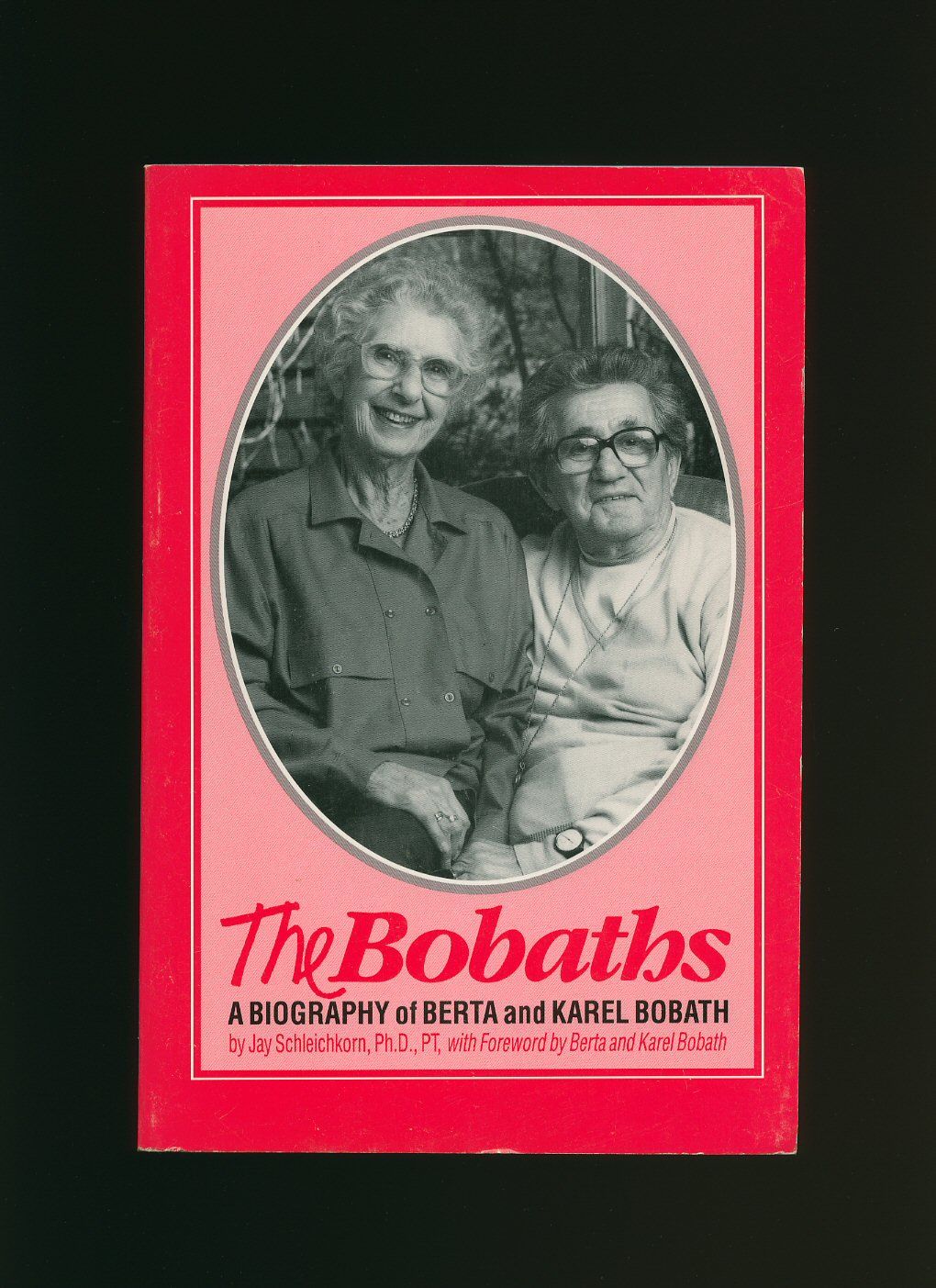
Neuro-Developmental Treatment. That's a lot of syllables. Very scientific sounding. It was developed by Berta Bobath, and for a long time was called The Bobath concept. Let’s just call it NDT/Bobath.

NDT/Bobath has been used on stroke survivors for decades and decades. When I was in school professors talked about it as if it was the most awesomest thing that had ever been awesome. It was the pinnacle. But it was complicated. It was so complicated you couldn't even learn it in school. You have to learn it from NDT/Bobath gurus. You could've gone to the Harvard school of physical therapy (if there was one -- which there isn't) and you still couldn't learn NDT/Bobath. Which is a red flag right there. If it works so well it would be required.

Instead, after graduating you have to go and get "certified" by NDT/Bobath gurus. Those gurus would've learned from other gurus, and up the pyramid it goes. NDT/Bobath training is expensive. We're talking about thousands of dollars and weeks of a therapist's life.

What could they possibly be teaching for that amount of time and money

NDT/Bobath uses "patient handling" where if you touch the patient in a particular way the patient would get better. Which makes no sense. If you could touch somebody and make them better that would be really nice. Touching is great. "Hands-on" is the way many rehab clinicians describe themselves. But does this hands-on treatment work for stroke? Is NDT/Bobath effective?

No and not really.

And how do I know this? Systematic reviews.  Systematic reviews can be used to figure out if anything is effective for anything -- at least in medicine. If you want to be sure that something is effective you turn to systematic reviews. It's basically a study of all the qualified studies of whatever the subject is. This study of studies either says the thing works, the thing doesn't work, or they don't know yet.

NDT/Bobath always does poorly in systematic reviews. And that should be the end of it, right? It doesn't work. Goodbye. But not so fast. I've been doing talks for years to therapists. I've heard every justification for continuing NDT/Bobath.

Here are some arguments made by NDT/Bobath therapists:

1. "There's research that says it works, and research that says it doesn't work. Its 'he said she said.' I choose to believe the research that says it works."

There are individual studies that say that NDT/Bobath works. Individual studies prove little. The real question is, what do all the studies say? Large groups of studies, from researchers around the world, can be looked at and analyzed en masse. These "studies of studies" are called meta- analyses and systematic reviews. For NDT/Bobath there are quite a few; links below. They all come to the same conclusion: NDT is not particularly effective.

2. "NDT incorporates all the latest research into NDT. Therefore NDT is research-based."

I call this the "Horshella." 

Person 1: "I love horseradish."  
Person 2: "Well I love Nutella!" 
Person 1: "Oh, horseradish tastes great with Nutella." 

Maybe. But we should probably test it before we market "Horshella". Smearing NDT/Bobath all over well run clinical trials does not make NDT/Bobath research-based. In fact, it destroys the original research by adding a debilitating confounding variable. Adding NDT/Bobath to a well researched intervention may make that intervention better, worse, or not affect it at all. But the original research was never done with NDT/Bobath, so we'll never know. Stealing other people's research and glomming it does not make your intervention research-based. All you've done is hijacked well run clinical trials, and in the process made everyone look bad.

3. "I don't need research to tell me something works. I've seen it work."

The world is flat. And I can prove it. Look out the window. See? I know global warming is not happening. When I got out of the shower this morning I was freezing! The sun revolves around the earth. Every day the sun comes up over there and goes down over there, so its revolving around us. 

"I've seen it work" speaks to clinical observation, a very important part of being a good clinician. But what if we were talking about cancer? If the oncologist said "I've have this treatment that I've seen work," your question might be, "What does the research say works?" Clinical practice without research is bad for cancer patients and stroke survivors. Clinicians are not blinded, they don't gather and analyze data, they don't have a control group, there is no elimination of confounds and on and on. Simply: Clinical observation won't tell you if A works better than B.


4. "Research doesn't know what works so I can use anything I want."

Here is the American Heart Association Scientific Statement on the Rehabilitation Care of the Stroke Patient. It mentions constraint induced therapy, electrical stimulation, robotics, etc. It not only doesn't recommend NDT, it doesn't mention NDT.

5. "What do I use for very low level survivors? They can't move and/or can't follow directions. So, I move them. At least I'm doing something."

Nothing else stops the plague so we're sticking with leeches. (The difference is that leeches may actually do harm. NDT does not do harm except in the sense that it leeches (!) $$ that could be better spent elsewhere.) 

Remember: There are only two kinds of true paralysis after stroke: Spastic and flaccid. Most survivors can move. Many, however are told not to move on their own because its bad movement, and will cause more bad movement. And who suggested bad movement will cause more bad movement (which is not true)? Bobath! Bobath called the movement after stroke "pathological" and insisted it be suppressed.  To quote Bobath's book, Adult Hemiplegia: The aim of treatment should be to inhibit the patient's abnormal patterns of movement because we cannot superimpose normal on abnormal movements. Let's say that a therapist was able to do this during treatment. Does the survivor not move the rest of the time for fear of abnormal movement?

Later... The movements the patient performs with or without the therapist help should not be done with undue effort. 

Tuesday, January 1, 2013

The problem with Botox

When it comes to spasticity reduction, Botox is the 600 pound gorilla. It is the Oracle. If Oz was the world of spasticity, Botox would be its Wizard. Allergan, the company that makes Botox dictates the conversation. Why? Cold hard cash. Allergan made significantly more than $1 billion in the third quarter of 2012 alone.
 

Keep in mind that Allergan makes other drugs besides Botox. And spasticity isn't the main reason Botox makes 'em money.  The main reason Botox makes money is because of its wrinkle reduction qualities. Bottom line: they have plenty of cash. And they use that cash to influence opinion. This is inevitable, but also unfortunate. The influence that can be bought chips away at a discussion of other possibilities.

What are the other possibilities?

Phenol blocks. In the book "Spasticity: Diagnosis and Management" phenol blocks are called: a "Dying Art" That Merits Revival.
 
Why does it merit revival? Phenol blocks do pretty much the same thing as Botox for spasticity. But it costs less. Much, much less. This is something you should discuss with your doctor. It may be true that Botox is the best option. But it may save you some money to ask about phenol blocks. How much money is saved?

For muscles in the arm/hand, this is one estimate...
Botox: $1014.84
Phenol: $7.85


Another thing about Botox. For a long time the suggestion by Allergan was that Botox should be administered, and that's it. Botox provided a "vacation" from spasticity. They are in the business of selling drugs, not in the business of reduction of spasticity in any sort of permanent way. Remember, Botox does not cure spasticity. Phenol blocks are the same. All Botox and phenol blocks do is provide a window of opportunity to to regain executive (brain) control over spastic muscles. A classic example is of somebody that cannot open their hand. Spasticity in the muscles to close the hand is so strong that they can't open the hand. Botox or a phenol block is used to weaken the muscles that close the hand. This "unmasks" the movement that was always there: Hand opening. Now the hand can open because it's not fighting the spastic muscles that are trying to close the hand. But instead of treating this as a vacation, the person works hard to get the brain re-involved in all the muscles. (Allergan has changed its tune about this with prompting by me and others. They now say: administer Botox and then get therapy.)

During the "vacation" block provide hard work can help permanently reduce spasticity. 

Otherwise, it's just a vacation.

Monday, December 24, 2012

Flexible and measurable DIY plan

Everyone needs a plan. At work we have schedules and care plans and goals. During our education we have schedules and syllabi and tests. Athletes, with the aid of coaches, have a plan for every practice, and benchmarks are built into every practice.

Most stroke survivors don't have a plan. Sure, therapists set a plan with goals during therapy. But once discharged, survivors tend to drift, hoping not to lose what has been recovered.  Instead, the most recovery is achieved when the focus is on further gains.

Upon discharge from traditional therapy, survivors enter a new chapter in recovery. Their recovery plan is essential in optimizing their recovery. This is true for the short-term, and for the rest of their lives. 

There are three aspects to every successful recovery plan.
 
Measurable benchmarks. Gains made during the chronic period after stroke are hard to see because they tend to be modest. Specific goals should be stated and strived for. If the patient says, "I will walk 500 yards by September," then a 500-yard route should be mapped out. The total goal should be chunked in a way that the survivor sees incremental gains toward the entire goal (i.e., 50, then 100, then 200 yards and so on).  

Focus on what YOU can do. For recovery to continue beyond the traditional therapy period, the survivor has to drive his own therapy. This dovetails well with the concept that for the brain to rewire, neuroplastcially, the patient has to drive his own nervous system. The recovery plan should emphasize self-reliance. Not only should survivors be able to do most of the therapy themselves, but they should also understand how to progress their efforts. 

Make the plan flexible. Stroke recovery research is galloping along. What comes of this research? New treatment options. All these new treatments dictates that the survivor be flexible enough to incorporate new ideas into their plan. But there's something else that requires flexibility: the survivor changes. One thing that every researcher agrees about: Intensity rules. So if the survivor chnages and intesity rules, the foucs must change while the level of intesity increases.

Otherwise you're just spinning your wheels.

Wednesday, December 19, 2012

Sen. Mark Kirk has skin in the game. Twice.

Below is a video of Sen. Mark Kirk. He had a stroke back in January. He appears to have left hemiparesis, and some dysarthria. He seems like a really hard worker who deserves to get every bit of recovery he can. He's a great inspiration. But.... He has this line at the very end of the video: 

"I can't wait to go back to work to vote to spend less..."

He is a fan of the way health care is being run now. And I guess he should be. It seems as if no expense was spared in his case. He probably has money, and that doesn't hurt. But much of it was paid for by his congressional healthcare plan. And here's some funny... 


Full article here.

Wednesday, December 12, 2012

You are an athlete.

[Addendum from a comment left by the author of the blog, "Thankful for everyday!" Here's the comment:
 
"When I first started having symptoms (not realizing I had a bleeding tumor) I thought I could "exercise away" all the bad feelings...it only made me worse. I was sure I would feel better after pushing myself, WRONG."

RIGHT! In both human and animal models, too much exercise too soon can make things worse! You should not put "the pedal to the metal" until the sub-acute phase. Its a long story, and a bit more nuanced (and detailed in the 2nd ed. of Stronger). Wait for the MD and therapists to say "Go!" After day 14 just about everyone is ready for intensity. But for some survivors it may be significantly earlier. And you don't want to wait too long, because then learned non-use sets in.]


There are two kinds of survivors who recover from stroke faster than others: Athletes and musicians. (Anyone who has been a high level athlete, dancer, musician, etc.)

And while the manifestation of individual strokes would make my hypothesis near impossible to test, there are three reasons to believe that it may be true. 

Reason one: There may very well be hypertrophy of the motor portions of the brain in both athletes and musicians. We know that massed practice will reconfigure the brain, with new neurons recruited and new pathways developed. And which populations are, by definition, involved massed practice? Athletes and musicians. 

Reason two: As anyone who is either an athlete or a musician knows, both these populations know how to train. And I don't mean just, "Yeah, I did my therapy today" kind of training. I mean the "I dream about therapy, wake up and plan my day around therapy and dedicate most of my time to therapy" kind of training. 

Reason three: Athletes and musicians are often extremely motivated to get back to their instrument or their sport.

Both athletes and musicians understand all the factors that are important to stroke rehab. They know how to practice with vigor and focus. They know the commitment of time and resources that such practice involves. And they know that if their practice routine changes, they will get different results. 

Successful survivors are true athletes. Their "level of competition" is somewhat limited, to be sure. But, on the other hand, they have the most devoted fans in sport: Their loved ones. And their families and friends have every reason, both altruistic and self-serving, to coach, cajole, encourage, support and embolden their athlete towards success.

Thursday, December 6, 2012

Fish oil may help recovery.

Note: With regard to any supplementation -- Ask your doctor first. Ask your doctor first. Ask your doctor first. Thank you.

Fish oil may help many aspects of recovery from stroke. In my book (now in the second edition, available for pre-order, just sayin') I put it this way:

 
 Fish oil may help stroke survivors in two ways:
 
1. DHA and EPA may help to reduce swelling in the brain after stroke.
2. Fish oil helps overall function of the nervous system and is considered “neuroprotective” (a substance that protects the nervous system).


Fish oil helps promote the neuroplastic process and appears to help the brain recover after stroke. Fish oil helps restore a neurotransmitter after traumatic brain injury. It may do the same after stroke.

Fish oil "treatment is able to facilitate functional recovery after (stroke)." It probably also reduces mortality after stroke.

Great general discussion of fish oil here. It turns out that cheap fish oil is just as good as the expensive stuff.

Remember, always ask your doctor first!

Tuesday, November 20, 2012

Saebo in the news...

I'm a fan of one of this blog's advertisers, Saebo. The two guys who started the company are brothers, both occupational therapists. (Find another set of brothers that are both occupational therapists and I'll send you a free copy of my book.) I like the culture that Saebo brings to stroke recovery. Everything they make has a commonsensical perspective engineered in. 

Saebo makes the SaeboStretch. Unlike static splints which hold the hand in a static position, the SaeboStretch allows the fingers to flex when they need to (often to protect the joints of the fingers). The 'Stretch then slowly pushes the fingers back to the desired position. 
Link here.

And, as it turns out, Gabrielle Giffords sports one!


Monday, November 19, 2012

Stinking after droke


As stated before, I'm not a big fan of drinking after stroke. I found some interesting statements here about the issue:

The effects of alcohol may put you at further risk after a stroke, and you will need to review your drinking and consider cutting down, especially if you were a heavy drinker beforehand.There are a number of factors you need to consider – talk to your GP for more advice: 
  • Following a stroke you may be more vulnerable to alcohol and its negative effects such as sleep disturbance, poor balance and impaired speech. 
  • Alcohol may worsen mood swings and depression, which are common after a stroke. It may affect your memory and thinking, making you forgetful and less able to make sound judgements. 
  • If you are out after dark, you should remember that alcohol can reduce night vision by 25 per cent and slow down reaction times by 10-30 per cent. 
  • Alcohol acts on the kidneys, creating excessive amounts of urine, which may make you dehydrated. If you are suffering from headaches, the dehydrating effect of alcohol is likely to make them worse. 
  • Alcoholic drinks are high in calories that have no nutritional value. If you are less active than before your stroke, you will need to reduce your calorie intake (especially these ‘empty’ calories) to avoid becoming overweight. Alcohol may make it harder for your body to absorb essential nutrients such as vitamin B1 and calcium. If you are less active and not absorbing calcium properly, your bones may become weakened. 
  • Drinking alcohol may be harmful when taking medicines that are sometimes needed after a stroke. Ask your GP or pharmacist about whether you may drink at all and if so, what the sensible limits are for you. You may be advised to stop drinking for the first month or two after starting a new medicine so that your body can get used to its effects. 
  • If you are taking blood-thinning medications such as warfarin, it may be important to establish a routine of what you eat and drink. If you do drink you should ask at your anticoagulant clinic about your alcohol intake and how much you can safely drink on a regular basis.
 By: "stroke recovery blog" "stroke blog"

Friday, November 16, 2012

Gotcha. Can't win, don't try.

Bill a stroke survivor has trouble putting on headphones. 

He is able to get the headphones on using just his "good" side. Here's how he does it: First an earpiece on the "good" side and then use the same hand to move the other over to his "bad" side ear. 


Now let's say instead of using only the "good side" he uses both sides. His "good side" hand picks up the headphones, and then his "bad side" hand grasps the other side of the headphones and he puts them on. But in order to get the "bad side" involved he has to do a bunch of weird movements. He hikes up his shoulder, pulls his arm away from his body, and uses an awkward grasp to put the headphone on his ear.

Which do you think would be better? Which would be better in the short run? Which would be better in the long run?

In the short run it may be better to do it with just the "good" arm. It might be quicker, and take less effort. 

But in the long run what would be the effect? First of all he'll never learn how to use both arms for that skill. Also, since he's only using the "good" side for that movement, all the other tasks that use similar movements would not be practiced. And a lot of things use that same movement (Brushing teeth and hair, shaving, feeding, etc.) So he'd have less practice specific to putting on headphones, and then less carryover of that task to other tasks.

But here's the funny part: There are a lot of therapists who believe that he should do it one-handed. The thinking is this: The movement needed to complete the task of both arms is "bad" movement. 

And, so the thinking goes, the more "bad" movement that you use, the more that "bad" movement will be "ingrained". Like a bad habit.

This idea, that "bad" movement should not be encouraged always struck me strange on the face of it. This is the thinking: "The more you move the worse you'll get." 

But everything we know about the brain suggests exactly the opposite. The more you practice something the better you get.

There is a weird assumption that is made: You will never try to move better, you will only use the "bad" movement forevermore. The idea is, survivors don't know what good movement is. Because survivors don't know what good movement is, you need a therapist there to correct you. Which... I don't know about you... sounds like it'll cost you a lot of money.

But let's say they're right. Let's say that if you do the task with both arms you would never do it "correctly." Now you have a decision to make. Do you do it "incorrectly" for the rest of your life, or do you not try to use the "bad" arm?

It was me, I would make the decision to use the "bad" arm. Why? Well first of all I stand a much better chance of learning to move the "bad" side better if I use it in every day tasks... every day. Second, movements from one task can feed forward to other tasks that used similar movements. So I might retrain not just for one task, but for a whole bunch of tasks. Third, I don't let the whole portion of my brain "lie fallow" and not do anything. The brain hates not doing anything. The brain goes through what's called "a pruning of the dendritic arbor." It's a fancy way of saying "use it or lose it." If a portion of the brain is not used, the neurons in that part of the brain start to shrink -- or "prune."

But there's another important reason to use any movement you have. Maybe, at the "end of the day" the task remains awkward and uncoordinated. So what? How many people play golf, enjoy it, but don't play perfectly (all of us)? How many people ski, and enjoy it, and don't have perfect form? What about music, or painting, or writing...

Bart: You make me sick, Homer. You're the one that told me I could do anything if I just put my mind to it.
Homer: Well now that you're a little bit older I can tell you that's a crock. No matter how good you are at something, there's always about a million people better than you.
Bart: Gotcha. Can't win, don't try.

 
 This is my suggestion: Continue trying to do everything. And every time you do it try to make it a little bit better.  

Everybody wants to be an expert before they start. But to become an expert involves a lot of hard work. May as well begin now...

 By: "stroke recovery blog" "stroke blog"

Tuesday, November 13, 2012

Function: You get what you want but not what you need.

Function. Function. Function. Function.
 
That's all you ever hear. "We're trying to get the patient functional." 
Why? 2 reasons: 

1. You want survivors to be functional. You want them to be able do every day, real-world tasks. When therapy ends, the therapist wants the patient to be able to do as much for themselves as they possibly can. Function is a good thing, no doubt. 

2. Generally, function is paid for. Lets say the goal is walking. If the patient is not walking, at some point, you have to end therapy. And with the ending of therapy comes the ending of payment.

But there's a problem with this "focus on function." I can be functional and walking, but require a cane an orthotic on my ankle. The cane is used to overcome the weakness of the affected leg. The orthotic on the ankle is used to overcome the inability to lift the foot. Focusing on function means overcoming a deficit. Sounds good, right? But if you are using a cane an orthotic have you really overcome the deficit? Maybe we shouldn't chew. We can put everything in a blender.

I've long been an advocate of a focus on recovery, not function. Think of recovery as a game of soccer. Function is a score of 1 to 0. You win. But there are two ways to win. One way to win is to pick up the ball with your hands and throw it in the goal. The other is training hard, practicing with your team, getting in good shape, practicing skills, getting in the game, and putting all the practice into, well, practice. Using the "good" extremity to accomplish goals (known as compensatory movement), orthotics, assist devices, etc. etc. does not lead to recovery. 

Very often function flies in the face of recovery area. For instance, a person may very well have some dorsiflexion (the ability to lift the foot at the ankle). But the movement is often weak and incomplete. Therefore it is "nonfunctional." And so it is ignored. And if a movement is ignored the portion of the brain representing that movement will get smaller. 

And so the ability to lift the foot will decrease. And so the movement is ignored even more. And so there is less brain involved, and so on and so on and so on. This process is known as learned nonuse.
 By: "stroke recovery blog" "stroke blog"

Thursday, November 8, 2012

Therapy is upside down.

When a survivor first has their stroke the brain is very vulnerable. And because it's vulnerable the survivor shouldn't do very much. The first few days after stroke is a time to convalesce. There is a time to add intensity to the recovery effort. But during the first few days, generally referred to as the acute phase, is not when intensity should be attempted. There are more important things to do. Like saving as much brain is possible (the domain of medical doctors).
So what do therapists do during acute phase? Most therapists involved in acute care will tell you the same thing: "We do whatever they can." That is, whatever the patient is physically able to do is encouraged. But there is often not very much the stroke survivor can do. Yet therapy immediately after stroke is generous. There is often hours per day slated for acute care therapy. But that's not when hours are needed. Hours are needed during the subacute phase.

The subacute phase is usually defined as "seven days to three months." But this is actually a misrepresentation. The fact is, like anything with stroke, it's different for every survivor. Each phase, in fact, happens in a different time for each individual survivor. In any case, it's the subacute phase when intensive efforts towards recovery should begin. Yet for many stroke survivors there's actually a reduction in the number of hours of therapy during the subacute phase as compared to the acute phase. In this way, therapy for stroke survivors is upside down.

By: "stroke recovery blog" "stroke blog"

Saturday, October 20, 2012

Here Come the Vendors

I do a lot of talks about stroke recovery. About 80 per year. I learn so much from the therapists I talk to. Many of them are committed, caring, bright and motivated. I like the fact that I'm doing my talk to good people.

But there is one segment of therapists that can be tough to love. 


Attending my seminars have been lots people from a variety of companies. These companies usually represent products. Sometimes they represent services, clinical trials, organizations, etc. But usually it’s products. And for me, these people can be very dangerous. They either want to know what I'm saying about their product or want me to promote their product. Those who want to know what I'm saying about their product never voluntarily tell me where they work. Those that want to promote their product are just the opposite. At some point in the seminar they'll approach me and talk up their product. And it's always uncomfortable. 

Many of the products have little or no scientific evidence behind them. Doing the research to provide evidence for a product is expensive and laborious. It's quicker, cheaper and less fraught with risk to just put your product to market, and promote it. And I become a part of their promotion. So when I'm approached, it usually feels like hucksterism. It feels like I'm being sold on a product so that my seminar might become a platform for promotion.


People will hand me their card, and talk about the product. That card will become a reminder to look at product up. So how do I look it up? I try to strip away the product name in order to get to the core of the product, and then research that core. For example, let's say somebody is selling Stroke-A-Way. If I look up Stroke-A-Way all I'll find is what Stroke-A-Way wants me to find. So instead, I look up the "active ingredient" (concept, or exercise, or whatever). I try to see if the active ingredient is scientifically based.

But what if it doesn't work? A lot of times I can go straight to clinical research sites during the seminar and look the "active ingredient" up. I can also send out a quick e-mail to experts in the field (I've been in research for a long time; lots of contacts) and ask their opinion.

So: What if the product sucks?

If the product has no evidence, I don't advocate it. And if you're a vendor, and I say your product
has no evidence, you'll be pissed. But you shouldn't be. You're at the course, you read the course description, and you know I'm in research. So... I'm going to do the research.

I wish these folks would read their diploma. On there- someplace- is the word "science." It'll be an Associate of Science, a Bachelor of Science, a Masters of Science, or Doctorate of Science. When you got your license you dedicated yourself to providing treatment options based in... science.

So bringing it up in the seminar is not just dangerous for me, it's dangerous for the vendor. What if, because the vendor made me aware of the product, I research the product. And what if I find no evidence it works? The next time somebody asks me about the product I'll say there's no evidence behind it. I have to. It's my job. It probably would have been better had they not talked to me about it at all.

You know what the most widely read entry in this entire blog is? The entry on neuroaid. I only became aware of the product because they copped the name of this blog; The Stroke Recovery Blog. The theft got my attention, and made me do the research to find out that it...
  • had a very low level of evidence behind it
  • was available in a less expensive form
  • used researchers who had a clear conflict of interest to promote it.
So if you get my attention, be prepared for the inevitable question: Is it evidence-based? This is my job. And I talked to  a lot of stroke survivors who want it to be the job of every clinician. Figure out what works, and then do it. And the stuff the doesn't work. Don't do it.

BTW: Frankly, I don't necessarily advocate the products advertised on this blog. However, I will not accept advertisement for products A)
that clearly don't work or B) competing products exists which better provide the "active ingredient."
By: "stroke recovery blog" "stroke blog"

Blog Archive