
Friday, August 18, 2017


Monday, July 31, 2017
Better movement through beer.
 |
| cutris.blogspot.com |
When you build a house you want to build a strong foundation. When a tree grows, it doesn't grow from the leaves inward, it grows from the seed outward. For every process of growth, there is a beginning, a foundation, a germinal point.
What is the foundation for movement after stroke? If you ask most therapists they will say it is trunk (torso) control.
 |
| Trunk Control |
Focus on trunk control is the analog to building a good foundation for a house. Trunk control, so the thinking goes, will provide a good foundation for the arms and legs to do their thing.
Therapists will often continually talk about the trunk as being the most important foundational part of the movement. The way it is taught in therapy school is "proximal stability for distal mobility". And this idea-- to work from "the inside out" is not wrong per se. It's just not particularly right.
Some therapists obsess about the trunk. But what if we flipped it? What if the driver foundation of learning movement is the hand? Or the feet? But I actually don't think it is those, either.
The foundation of movement is the will of the mover.
- Mind: Expressed as intention (I want to do something)
- Brain: Starts the movement (Expressed as an electrochemical command)
- Muscles: Move the limb (muscle contraction)
- Hand: Expresses the original intention (grab a beer)
Imagine an infant. They reach because they want something. There is no one there to hold them and they may be a little unsteady, but their intention to reach makes their balance better.
The “will” of the hand drives the changes needed in the trunk. The trunk will learn, in a natural way, to get the hand where it needs to be.
Thursday, June 1, 2017
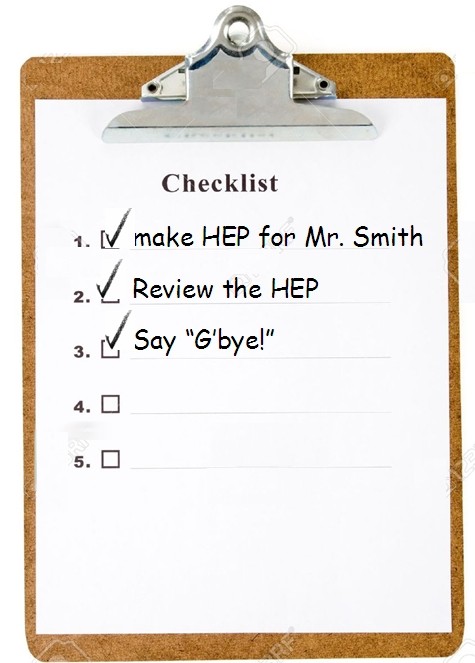
Make the Home Exercise Program AWESOME!!
Years after stroke survivors have been discharged from therapy, recovery can continue.
Of course, the speed of recovery diminishes over time. There is
no time that is quite as fertile as the period of natural recovery in the first
few months after stroke.
But recovery can continue. Stroke survivors should be
encouraged to see discharge from therapy as not the beginning of the end, but
as the end of the beginning. The baton of the conductor of the grand symphony
of recovery is passed from therapists to survivor.
Most of the time
therapists will leave stroke survivors with little guidance for
further recovery. Some therapists think “HEP” stands for “Hand ‘em
photocopies.” Too often the HEP reflects nothing more than a watered down version
of the exercises that were done in the clinic.
Irony: The survivor is left with the same exercises that caused the very plateau that caused the discharge!
Therapists have a very good reason for prescribing the same exercises as were done in the clinic: They don't want you to go home, do an exercise that you don't fully know how to do, and get hurt.
Therapists have a very good reason for prescribing the same exercises as were done in the clinic: They don't want you to go home, do an exercise that you don't fully know how to do, and get hurt.

A good home exercise program
will help the survivor to continue making progress once they are home. The HEP can and should be started the day the therapist meets the survivor. Therapy itself can be part of the HEP. If the survivor and caregivers can see what goes into the basic concepts that
therapists use all the time, they will be able to direct their own recovery
long after they’ve forgotten your name.
The HEP should explain:
àprogression of
exercise,
àmeasuring and documenting progress,
àtips on equipment needed
for a home gym.
Therapists: Your job is done. You would have liked more time with them, but this is all manged care has allowed. At least, you’ve helped them to be functional, safe and return home.
Survivors: Your job has just
doubled. Not only do survivors have to continue the quest towards recovery through
their own efforts, but they have to do it without therapist's guidance. Leaving stroke survivors with the
tools they need to continue the quest is critical helping them to be in the
best position to reach the highest level of potential recovery.
Tuesday, May 2, 2017
Facebook Recovery

If you want great ideas for recovery, where do you find them? One of the best resources— I turn to it all the time for ideas— is the Young Stroke Survivors Global Network. Its a Facebook page chockablock full of suggestions, discussions, videos, links...
And lets face it... a lot of stuff on the web is either complicated or dubious:
Complicated: clinical research
Dubious: websites that exist to sell you something
Young survivors (young= willing and able to hyper-focus on recovery) come up with the best ideas. They're often educated and ambitious and willing to try to "push the issue."
Wednesday, April 19, 2017
“Pusher” Syndrome-- the neuroplastic model of recovery

Pusher syndrome (PS) is an altered sense of reality.
Survivors with PS (sometimes known as "pushers") believe that they are sitting or standing “upright” when they are tilted approximately 18° towards the "bad” side.
Therapists may be exacerbating pusher syndrome. When survivors with PS are forced to a “upright” they feel like they're leaning too far towards the "bad" side. “Pushers” react to this feeling by leaning towards the affected side. They see any attempt to get them truly straight as a serious threat that inspires fear.
Another term for pusher syndrome is listing phenomenon. This may be a more accurate term because "pushers" only become "pushers" when they are pushed. Anyone who was shoved 18° out of balance would push back! There are other terms that have been used for PS including:
· ipsilateral pushing
· contraversive pushing
· pusher behavior.
PS affects approximately 5% (although some estimates are as high as 50%) of all stroke survivors.
Survivors with PS have had damage to portion of the brain that controls the feeling of upright body posture. The area damaged is called the posterolateral thalamus. Loss of this area causes PS.
Balance is determined by 3 systems: vision, vestibular (inner ear) and proprioception. Patients with PS typically only have damage to one of the 3 systems: proprioception. Clinicians can help by directing patient focus to the balance systems that are still intact. Therapists can help pushers by helping them to attend to vertical visual cues. One technique involves having the therapist sit in front of the seated patient. Then use any visual cues available in the room, or the therapist’s own body (i.e. the forearm held vertically) to have the patient reorient themselves to true vertical. Carr and Shepard (reference below) suggest having the patient purposely, and within a safety-controlled environment, repeatedly reach for an object towards the hemiparetic side. The patient is then instructed to bring themselves back to visually confirmed true vertical. This simple technique hits on two basic concepts of the neuroplastic model; task specificity (reaching for an object creating a challenge to balance) and repetitive practice. The repetitive practice in this case is repeatedly reorienting to true vertical. Therapists can help pushers by teaching the necessary movements needed to realign to vertical. As is true with many of the recovery options that drive neuroplastic change, it is repeated self-correction that rewires the brain.
Pushers should be encouraged to hold a vertical position no matter what everyday task they’re doing. This incorporates another core concept in the neuroplastic model: massed practice. Therapists who encourage constant realignment to true vertical—in and out of the therapy gym—help the survivor mass their attempts at righting and equilibrium reactions.
Although certainly not proven, I would bet that the rewiring necessary to correct PS does not happen in the thalamic region—the region damaged in stroke survivors with PS. Using repetitive, task specific massed practice may instead force an enlargement and/or strengthening of the cortical representation of the intact vestibular and visual systems.
Therapists can help PS patients by providing shepherding guidance on this necessary neuroplastic journey.
1. Karnath HO, Broetz D. Understanding and treating "pusher syndrome". Phys Ther.2003 Dec;83(12):1119-25.
2. Shepherd RB, Carr JA. Response to Discussion Paper: New aspects for the physiotherapy of pushing behaviour, D. Broetz and H.-O. Karnath, Neurorehabilitation 20 (2005), 133-138. NeuroRehabilitation. 2005;20(4):343-5.
Tuesday, April 18, 2017
Work the good side and the bad side gets...better?

I do a lot of talks. Tons of them. Constantly. To therapists. And I say to them usually early in the day, "Look, I'm staring down the barrel of hundreds of years (sometimes more than a thousand) years of clinical expertise. One of my goals today is to have you share your best ideas. That way, tomorrow, when I do another talk, I can present your idea, claim its my own, and give you no credit." They laugh. Its funny because its true. And they do give me their ideas and I do steal them and then present them in my book, articles, talks, or this lovely blog.
And here's a stroke-recovery strategy I got the other day form the fine therapists at BONE Physical therapy and Rehabilitation (they appear not to have a website, but that link will at least get you a phone number.) They're in Columbus, GA.
Training the "good" side
In folks who have not had a stroke, we've known this for decades: If you strengthen only one side (say, your left side) the other side strengthens too.
It's true in survivors as well: If you strengthen (so says some preliminary research) the unaffected side, the effected side gets stronger. A researcher at the University of Victoria, Canada, Katie Dragert, appear to be the scientists who have explored this issue the most.
Here's an example: If you do resistance training for the dorsiflexion on the "good" side...

... the "bad side" gets stronger.
How did they do it?
•Stroke survivors did performed 6 weeks of maximal dorsiflexion.
•What did they gain on the "good side"?
~34% strength increase on the "good side."
•What did they gain on the "bad side"?
~31% strength increase on the "bad side."
We also know that bilateral training -- when you use both sides together, the "good" side helps the "bad" side become more coordinated. your challenge is to find a way to put these two concepts...
1. strengthen the good to strengthen the bad
2. use the good to train the bad
into recovery.
Thursday, April 6, 2017
"My dream for the future is to help as many people as I can possibly help"

Survivors, to varying degrees, are usually pretty good at explaining with appropriate passion what its like to have, survive and thrive after stroke.
One of best I've found so far has been Bill Torres. Find his story here. (Bring tissues.)
 |
Tuesday, February 28, 2017
Drink Up!

I got an interesting question from a therapist at a recent stroke talk: "What is the effect of dehydration on stroke recovery?"
I said what I often say when interesting questions come up that I don't have an answer for: "Email me that question… We'll look at it together"
It turns out the dehydration is thought to be a cause of stroke.
Further, if a stroke survivor is dehydrated when they're admitted to hospital, worse recovery can be predicted. And dehydration when admitted is predictor of discharge to long-term care (read: nursing home).
So, drink up! because, more than one third of all survivors will have another stroke.
Or to put it all research-y: Dehydration is a predictor of poor outcomes including discharge to long term-care.

Saturday, January 14, 2017
Can Stress Cause a Stroke? You bet!
 |
| If you've had a stroke you have ~35% chance of another stroke. Finally proof: Stress can cause a stroke. (Stress= ↑ Blood Clotting = Stroke) |
(The Lancet abstract to this research here. Non-nerd take here.)
But the connection between stroke and stress is indirect. Here's the story:
The amygdalae (plural; there are 2 of them. Singular: amygdala) are small marble sized structures responsible for emotions.

In folks who have cardiovascular disease (like stroke) there is more activity in the amygdala.
This increased activity causes more C-reactive protein in the blood. C-reactive protein— you guessed it— clots blood.
Blood clot in the brain = stroke.

Saturday, November 19, 2016
Stroke Shoulder Pain........ More drugs? ............................. Maybe not.
Shoulder pain after stroke, its causes and some treatments I plan to post about soon. However, there is one treatment I want to focus on up front, because its new and has tremendous potential.
It's called the StimRouter. Its made by the company Bioness which you know because of their electrical stimulation (E-Stim) machines:...


But they have a new treatment for pain. But we're talking shoulder pain, so allow me to focus on that...

Cool vid here:

Saturday, October 8, 2016
$troke $urvivors: YOU COST TOO MUCH-- GET OUT!


Hospitals cost big bucks. So managed care (insurance companies) want survivors out of the hospital ASAP. Because of this rush, doctors and therapists are forced to push the survivor into the next step of rehab.
The problem is that there is no way to tell what the survivor actually needs. To put this a research-y way "There are varying degrees of spontaneous improvement in arm paresis over the first 6 months after stroke."
Making the "where should they go" decision during the 2-5 days survivors are typically in the hospital a problem. The survivor’s brain has not even begun to reveal what its capable of. In the hospital the survivor's brain has not revealed what it is going to be in one week, let alone one month or one year. Still, therapists and doctors are forced to push the survivor out of the hospital to the next step. And the "next step" choices matter. The "next step" impacts now and for the rest of the survivor's life.
Thursday, September 1, 2016
Overchallenge for Stroke Recovery


 Overchallenge forces something to change. The word forces is important. Some of the best strategies for recovery involve forcing the survivor into something that challenges them towards recovery.
That last sentence has a lot to unpack. So lets unpack...

First, "forcing the survivor" is not really correct. The survivor forces themself. No one likes to be "forced" to do anything. Plus, it won't work that way. When it comes to relearning movement after stroke, no one can force you. I can't force you to learn movement. But you can, and do, force yourself to learn. That's the way it works: The brain changes according to the owner's wishes. So, survivors self-force their own overchallenge.

Second, the word forced is accurate because that's exactly what is done. Take forced use. Forced use is when the survivor uses their "bad" side for a certain amount of time.

FUT: The survivor uses only their "bad" side for minutes to hours per day, at home.
CIT: The survivor has their behavior "shaped" by a clinician with repetitive practice of component parts of a skill. It is usually done with 3-6 hours of practice in the clinic with a therapist, as well as FUT done at home)
(Note to nerds: Forced use therapy (FUT) and constraint
induced therapy (CIT) often get confused.
FUT: The survivor uses only their "bad" side for minutes to hours per day, at home.
CIT: The survivor has their behavior "shaped" by a clinician with repetitive practice of component parts of a skill. It is usually done with 3-6 hours of practice in the clinic with a therapist, as well as FUT done at home)
Third, overchallenge requires a forcing into an area that the brain is uncomfortable. Usually, the concept of overchallenge is associated with muscle building. But with regard to stroke recovery, overchallenge has to do with brain building. And the brain does not want to build. It does not want challenge. Because here's how the brain looks at it "Why should I challenge myself? If I do, I will change. And what if I change into something I don't like?"
But overchallenge is exactly what the brain needs to recover. Here are a few of recovery strategies that use the overchallenge concept:
1. Constraint induced therapy
2. Forced use therapy
2. Forced use therapy
But overchallenge could be walking longer distances, challenging your balance on uneven surfaces (safely, of course) not relying on aids of various kinds, etc. Even something like reaching...even ...further, across a table for something has the ability to overchallenge.
Sunday, August 14, 2016
Neuroaid: Partial Truth and Petty Theft
Note: This entry was originally written in 2011, and edited several times to update info as it became available.
However, the last time I edited it, Blogger changed the URL and redireced everyone trying to find this entry to a dead page (C'mon Google- don't be evil!).
So, here is an updated version. Comments on the original page are at the end of the entry and are very worth the read!
http://recoverfromstroke.blogspot.com/2011/04/neuroaid-theives.html
Thanks! -pete

- Click here to find the extent of the scam.
- (Reuters) "Herbal stroke remedy no
better than dummy pill"
- Wikipedia page on neuroaid
Amendment: August 12, 2013: A well run clinical trial using 1000+ participants showed neuroaid "...is statistically no better than placebo in improving outcomes." Find the results here.
(Thank you Ali Hussain
Ali).
From April 16, 2011:
Bottom line
- Neuroaid is a drug that is made
from traditional Chinese herbs.
- Cost: $1,346
- Effectiveness: The company says
it works. The research disagrees.
Neuroaid has long been
an easy joke among neurologists, physiatrists and researchers. Here is an
actual email:
Colleagues:
It
looks like millions of lives will be restored. How absent minded of me to tell
patients that there is no “magic bullet” for all of these years…and shame on
you therapists and physicians for not giving the below to your patients. Thank
goodness for Neuroaid.
I really had no opinion
about it because on the face the claims seemed dubious so I never took the time
to unpack the research.
But that all changed
when neuroaid decided to call their blog The Stroke
Recovery Blog (TSRB). They did this in 2010. It is true: You
cannot copyright a blog name, especially not one with a generic name like TSRB.
But they picked this name for a reason: It is an established name in
stroke blogs, has been around since 2008 and is generally respected. ("So when folks look for that blog, they'll
find our blog- We are geniuses!")
(Amendment: March 7, 2014: I have since changed the name of this blog. This had nothing much to do with neuroaid's weird co-opting. It had more to do with the fact that the blog is an adjunct to the book, Stronger After Stroke)
In any case, their choosing to steal this blog's name made me realize that the company that makes neuroaid may not be completely truthful.
So I did a bit of
investigation....
There are several
problems with their research.
- There is an
obvious conflict of interest with regard to many of the folks
involved in the research. That is, the people who are doing the research
work for the company. This is bad, and it happens all the time. The profit
motive may (or may not) sway the researchers to "massage the
data" so that the data suggests that the product is AWESOME!!!
- Consider Marie Germaine Bousser (this link is now dead, probably because of this writing. In fact, Dr. Bousser appears to have worked hard to distance herself from the company, online at least...). She is (was?) on neuroaid's scientific advisory board. She
is also one of the researchers of the product (last author). The same is true with others on neuoraid's
scientific advisory board. Here's my question...how do they get away
with that? The lab I work in does trials of products all the time but
we have to sign conflict of interest forms that clearly separate us from
the product tested. A lab can get itself in trouble (and often
through sheer osmosis, other labs at the same and related universities)
when you get paid for your "research." (If you want a nerdy take
on this issue, click here.) There are a few studies on neuroaid that show up in Medline. Only one of the studies, from Iran, does not involve
at least one author that is on neuroaid's board.
- (addendum 6.7.15: Interesting fact: The study
in which neuroaid has touted, called the
CHIMES-E study, is thick with conflicts. First, at least 2 of the
authors are on neuroaid's scientific board. Further (you can't make
this stuff up) neuroaid's parent company "... provided
grants to the CHIMES Society of which the society had sole discretion on
use." And, uh, one of the authors owns stock in neuroaid's distributor.
And, the name of that distributor? E*Chimes! Has a ring to
it!
- Neuroaid is made with "12 different Chinese herbs plus extracts of leech and scorpion." that are probably available in any Chinese drug
store in any major American or European city. You can also buy some of
them online. Here's one on Amazon. Here is another herb called
"Strokaway." Here are more. Scorpion venom here.
- (Have a look at Mike's take on
this in the comments section link at the bottom of this post for more info
on obtaining the drug in alternative ways. Thanks Mike!)
- According to their site
"...the price for NeuroAiD .... One month of treatment is US $488,
including shipping fees. The standard 3-month treatment costs US$1,346
including shipping fees."
- The main way of measuring the
drug in their biggest clinical trail was something called the
"Comprehensive Function Score component of the Diagnostic
Therapeutic Effects of Apoplexy." Measuring recovery after stroke
is my area. Since the late 90s I've done all kinds of tests of recovery
from stroke. I've never heard of the the test they use. And there is no
way to research it. Medline has no mention of it. Google only produces
results that reference guess who? (Apoplexy is a term that has
not been used to describe stroke since Andy Griffith!)
- An interesting discussion here. My favorite line: "not surprised that neuro
aid is expensive... I wish I could get my hands on those people."
- Neuroaid claims it increases
BDNF, a protien in the brain that helps recovery from stroke. As with many
of their claims, there is a grain of truth here. They did find an increase
of BDNF in one French rodent study.
- "Alternative medicine that
works is called medicine." I think my colleague's email, in blue
above, suggests the primary problem. If neuroaid had reached the level of
evidence that neuroaid claims then why would MDs not suggest it's use?
Because MDs don't want people to recover because....uh...
- NOTE: I don't know
this drug does not work. But by any stretch, the evidence is thin.
Bottom line:
- A company makes
strident claims with little research to back it up.
- Company's PR firm decides to
hijack "hits" from this blog to their profitable website
disguised as a blog.
- Reference articles
30 comments:
Mike said...
I had a chat with a
Chinese doctor when I found out about Neuroaid when I was 6 months post-stroke.
He saw the ingredients and told me that they were very popular in China, and
all would cost $ 1.00.Of course Asians believe that the herbs work because of
their long tradition helping patients over that side of the world together with
acupuncture and massage. But hard work is the most important force that drive
the recovery of patients over there. Herbs alone don't do much.


Mike said...
NeuroAid is equivalent
to the "Great Yang Restoration Pills" popular in China but so much
cheaper. Do the pills work? The Chinese prefer the freshly made tea because all
synergistic components are present in the right amount.
oc1dean said...
They've started
posting on some of the stroke blogs. And when I called them on the provided
research.
They replied back listing this research as proof.
http://content.karger.com/produktedb/produkte.asp?typ=fulltext&file=000155220
I read this and pointed out that this sentence in the report showed that there was no scientific benefit.
The impact of Neuroaid treatment cannot be differentiated
from the contribution of natural recovery, medication and physiotherapy effects. However, all cases reported
improvements. The next day the complete post was gone and a forum representative called me a liar when I posted the exchange again and basically said that Neuroaid must have complained to the forum to get the posting deleted. The forum denied ever deleting it and came close to blackballing me again.
Keep up the good work Pete.
Dean

Peter G Levine said...
Thanks Mike and Dean
for your comments. Dean, I fully expect there to be some sort of fallout. Don't
be surprised if this blog gets hacked somehow. I would like it if they'd
contact me. Maybe I'm missing something important.
Elizabeth, John,
and Jack said...
My question....Could
it be harmful??? I'm probably doing a lot of things that might not help, maybe
they will, but they're not going to hurt me. While objective clinical data is
always best, to do no harm is at the top of my list too. I just want to keep getting
better. I'm doing all the hard work already, adding a supplement seems like an
easy add on.
Peter G Levine said...
There are 2 ways of
looking at the safety issue. 1) This or similar drugs have been used in China
for a long time. 2) There are studies on safety of what is alternatively called
MLC601, Danqi Piantang Jiaonang (DJ) and MLC901. They all indicate safety. Keep
in mind, there are 7 studies of the drug. Please see the reference link at the
bottom of the blog entry, which I've added to help you answer your question.
amina said...
to mike i wanted to
ask you that i had a stroke at the age of 23 im nw 24 its been jus over a yr
and was hoping if its still worth going to see a chinese herbalist as ive come
to a stand still in my recovery rate can u offer any help?
jacque said...
RE:advertisement on
t.v. concerning stroke. The ad says to get treatment within 3-4 hours. But does
not say that there is a new drug that must be administered within that time
frame and will reverse the effects of the stroke completely. Rather than stress,
or along with stressing the time frame, they should stress the benefit of the
drug as well.
jacque said...
The AMA and the ads on
t.v. need to stress not only time factor in responding to a stroke,, 3-4 hours,
but also that there is a new drug that will reverse the effects of a stroke
when administered in that time frame. With emphesis on the DRUG & TIME frame.
thank you
thank you
Evo said...
I too fell for the
touted benefits of NeuroAiD. Searching the internet for anything to help my
recovery, I unfortunately took the bait, hook line & sinker. In my humble
opinion, a complete waste of money.
A lot of money!! $1400 for a one month supply. Save your money & find someone trained in traditional Chinese medicine. They can provide the exact formula at a fraction of the cost.
On another note, I did have some good results with hyperbaric oxygen treatments
A lot of money!! $1400 for a one month supply. Save your money & find someone trained in traditional Chinese medicine. They can provide the exact formula at a fraction of the cost.
On another note, I did have some good results with hyperbaric oxygen treatments
Peter G Levine said...
Evo: Thanks for the
comment. I'm skeptical about hyperbaric.
deirdre said...
i just found this
site...a man in the care place near my mom had some wound treatment in the
hyperbaric chamber - i was told by one of the aides or nurses that as result,
he had a stroke (he had it done at the hospital)
what a shame!
what a shame!
TinaMarie Alaimo said...
Hi All,
We used NeuroAid on our daughter, in a super dose. She got 2 capsules 4 times a day for close to 8 months when she was home after the stroke and a couple of months in a rehab hospital. She is a super miracle. Without the NeuroAid she would still be in a wheelchair and sleeping all day long. Now she DRIVES her kids to their sports and even does her own exercising now on her own. Shopping, driving, housework and cooking,, she does it all.. try it you'll like it......
I hope you use it if you can afford it.
Peter G Levine said...
TinaMarie: That's
great news. But, as I'm sure you know, your story is at best a case study with
an "N" of 1, uncontrolled, not blinded nor with standardized outcome
measures. I'm glad your daughter made fantastic progress, but there is no way
to directly tie recovery to the product.
Geofio said...
Hi I am just about to
buy neuroaid for my brother who took a stroke in march this year aged 43 ,I
admit I am fifty fifty on whether to believe it or if it is a load of bull,but
at same token I don't want to watch my brother suffer knowing what might have
or could have been if I don't try it,I understand everybody's view on why does
doctors not just prescribe it everywhere if it is so magical ,I have my own
opinions on that,,anyway when. Purchase this and try my brother on this I will
return here in a few months with an honest opinion, I am not the type of person
who will exaggerate or kid myself on oh this has made great improvements if it
has not, as I would hate anyone else in my position to waste money when they
could use it on something else that could help them or a family member, so as
said I will return here again, I don't give up for my brother I never ever I'll
he has right hand, arm paralysis and his foot also not too good,I will monitor
all of this as I go and help with his home exercises, miss Fiona McIntyre
hoping I can bring great news to anyone else in this position and to my brother
also he's a great person who deserves I try this for him..
Ali Hussain Ali said...
Chimes study failed.
Neuroaid doesn't work
end of story
Neuroaid doesn't work
end of story
Peter G Levine said...
Two comments:
1. Ali, please list your source info instead of just dropping a bomb like that! I am trying hard to make informed decisions. Also would love list of NeuroAid advisory board members.
2. Also, really doubtful about hyperbarics (HBOT) causing a stroke. The depth(or atmospheres)for wounds is much greater than for CNS issues. It has a great safety rating and is showing improvements for neurocognitive deficits but not enough controlled studies for that yet. Money isn't in it because it isn't a drug that can be patented! Daughter used HBOT for cognitive insult from tumor removal, best and lasting result was improved balance! Also greater interaction with people.
Peter G Levine said...
Please note that the
actual study is in the link at the top of this blog entry. Also, I'm not seeing
where anyone claimed HBOT causes stroke. But it has no proven efficacy in
humans/stroke.


Andrea Hanson said...
This comment has been
removed by a blog administrator.
Francis Dizon said...
Joanna Tan said...
Hi All. My dad had a
stroke in Aug 2013. I found his almost motionless inside the shower room at
about 2 am and immediately called for an ambulance which they confirmed he had
a stroke at 4 am. I left the hospital and returned next morning around 9am and
was very sore to see his left facial paralysis almost too sudden.Our family was
introduced by a friend on NeuroAid.we were not able to afford even after making
alot of calls to check and beg for a discount. Someone told us it was
originated from China and is costing alot cheaper. Immediately we managed to
get someone to buy from China and for a 2 months supply which is also the
minimum dosage to "heal" my dad. Aside to the price different, this
supplements make miracle. Our family witnessed how fast it healed my dad.on
that firat morning and evening that he consumed the pills, that very evening
his facial paralysis was completed lifted up just like before but his speech
was still not completely clear.now after almost about 8 months and with 2
cycles of 2 months NeuroAid pills, he is able to work and eat himself. I
strongly believe NeuroAid has it effectiveness. Is more than a miracle that we
actually witnessed the fast reaction of this supplements.
Lynn said...
Hello Geofio,
please can you update on the outcome of your brother whom you bought nueroaid please.
please can you update on the outcome of your brother whom you bought nueroaid please.
Kim York said...
hi my 28 daughter
suffered a stroke on 14/3/14, affected left side of body - hardly any movement
in left arm and whilst left leg was responding well and she had regained normal
walking movement this has been severely reduced following an angiogram on 28/4.
Considering Neuroaid but concerned about financial outlay as low income family
- will be buying on a credit card. Would be interested in opinions and Geofio
update on the effectiveness of the product on his brother. Will also be trying
acupuncture and hypnotherapy. Many thanks Kim
Joel Quintero said...
I just want to say
with mother NEUROAID worked!
Peter G Levine said...
There are 2 claims
here that neuroaid worked.
I was at a local flea market the other day. There was a guy there hawking a cream that he said had crystals in it. 2 days later my daughter hurt her knee. We put the cream on her. 2 days after that, her knee felt better. Its a miracle! It works!
Or not.
This is why well controlled studies by folks who know how to do studies are helpful.
Everyone wants to believe there is a cure to stroke. Those same people wouldn't know an independent variable or a case series or what an institutional review board did it if hit them in the head.
Ginny Spencer said...
Hi! I had 7 strokes in
late '09 leaving me completely right side paralyzed. After 6 months of pills I
started reducing and eliminating them. Continued with PT / OT after finding an
authentic Traditionally trained Chinese Acupuncturist who also does Chinese TCM
herbs.. and has taught in the area for over 2 decades. I showed him the
information that I was lucky to have found regarding both Neuroaid and Moleac.
I had the ingredients list and copied them down in a notebook. (Moleac is the
European version without any animal products). My TCM Dr told me these are
common TCM herbs and products and don't cost a fortune. We put together his
version and I have been doing acupuncture with him. I can see and feel the
difference over a matter of months. But, as Mike said, "Herbs don't do it
alone". You must do everything you can to get better". That includes
EXERCISE, Proper NOURISHMENT, CLEAN WATER, PT/OT, Meditation, Massage,
Reflexology, and surrounding yourself with Peaceful Positive People. Your Caregiver/Carer
needs this as well! I am now nearly 5 yrs post stroke - walking (jagged but on
my feet), raising my arm to a certain point (working on it daily), my speech
normal, my shoulders even now, and OT has me standing with a racquet, swinging
(with both hands) and hitting nearly every ball thrown but not yet stepping
forward. I am standing with a racquet and hitting almost every tennis sized
ball these days in OT (using mainly the affected arm, holding the bottom 2
inches supporting with the good hand) So don't put down methods that are
1,000's of years old just because you listen to a Western Dr. I, also, use
e-stim 2X (ZYNEX brand NMES unit), CRYODERM lotion for muscle pain, and soak in
Epsom salts using a Bath Lift. The Stroke affected side has a loss of
circulation or poorer than the unaffected. Keep stimulating that affected
side!! DEEP tissue massages (BREAKING DOWN the Ligatures that tighten down
causing spasticity) in the palm of the hand, up the arm both sides, into the
shoulder and the back, down the legs at least twice a month. Daily or weekly
have Reflexology done on your feet and hands, using Arnica oil mixed with
Peppermint lotion (with real essential peppermint oil drops)does wonders! NEVER
give up! Stretch your fingers back with the other hand, keep your wrist supple.
Have someone [lay "This Little Piggy" with your toes! AHhhhh, yeah!
That's why Moms all over the world do that with their babies! I have a SAEBO
stretch for night use and a SAEBOflex for daily workout. The flex holds my
fingers OPEN so that I am working the weak muscles on the posterior side of the
forearm...which does affect the muscles in the upper arm. COMPLEX beings that
we are!!! In the gym, I have graduated from the rehab equipment to the
stationary cycle (for endurance), the rower (which bends the toes), the (caged)
elipitial (which teeaches you how to walk (if done turtle slow), and find
what's lacking is a steering wheel, shifter, and foot pedals... ya with me?!!!
Check out the site Bcenter.com that informs and is raising $$$$ to build a
Center in SE Orlando where Stroke Survivors may go for productive therapy at
reduced cost for 6 weeks a year. Get well! Surround yourself with positives and
positive people!! Do Brain Games, get your fav music on an iPod, get out and
about. Most of all, be patient with yourself!
Rey said...
My wife had a
hemorrhagic stroke last 01/25/2014 and affected her left side. She was in the
hospital for 39 days. After PT,OT SP, she can now walk slowly with a 4 point
cane but she has problems when her left foot get stuck at carpets, doormats walking
on uneven ground. Her left arm, hand and fingers are still very weak. She could
hardly grip or raise her left arn. I would like to know more about NeuroAid if
it really works. Waiting for Giofio's update on his brother.
Func said...
Here is the list of
sites where they run the trial:
https://clinicaltrials.gov/ct2/show/NCT00554723
You can find the results here:
http://www.ncbi.nlm.nih.gov/pubmed/23780952?dopt=Abstract
http://www.ncbi.nlm.nih.gov/pubmed/24135924?dopt=Abstract
https://clinicaltrials.gov/ct2/show/NCT00554723
You can find the results here:
http://www.ncbi.nlm.nih.gov/pubmed/23780952?dopt=Abstract
http://www.ncbi.nlm.nih.gov/pubmed/24135924?dopt=Abstract
LikeToStudy said...
This was published by
Reuters, a highly reputable business publication. If this was successful, it
would skyrocket the stock, but investors want to know the whole story. That
large 3-month study that was done, that did not publish the results, failed. My
suspicions were correct. If the study showed some efficacy, they would be
broadcasting it all over the place. It would take their company stock to
millions, if not billions of dollars.
Here is the link to the Reuters article.
http://uk.reuters.com/article/us-herbal-stroke-remedy-idUKBRE9640U620130705
Following is a link to the source and final results of the study.
The Conclusions was, that MLC601 (which is Neuroaid) is statistically no better than placebo in improving outcomes at 3 months when used among patients with acute ischemic stroke of intermediate severity.
http://stroke.ahajournals.org/content/early/2013/06/18/STROKEAHA.113.002055.abstract?sid=0f60272c-96a4-48d2-b395-36b543d74b67
Keep in mind, that this does not mean Neuroaid is a scam. Although it is definitely overpriced for the ingredients in it (a blend of extracts from plants, leeches, beetles, scorpions and antelope horn). This just means, that when put to the actual test, Neuroaid patients showed no significant difference improvements over the placebos. That means that there possibly could be a small improvement, but it would have been so small, that it could easily be attributed to chance.
In short, the company pushing Neuroaid, Moleac, takes great pain to mislead people on the benefits on Neuroaid. Their write-ups indicate that the real double blind studies which showed no improvement in using the product, as showing significant improvement. That is just an outright misleading lie. They also setup blogs that are closed (I assume, so that no one can point out the discrepancies) and of course, there is the glowing reviews on other blogs, that tend to be the same person.
Last, people tend to want things to work out right for themselves, especially when they pay heavily, and often will attribute benefits to some magic elixir, that had nothing to do with those benefits.
THE STROKE RECOVERY
BLOG
Subscribe to:
Posts (Atom)