Monday, April 29, 2013

Details are the devil

Because it involves the brain, stroke recovery is complicated. The brain is complicated, so anything that involves the brain is complicated as well.

Except that's not true. And it's more than not true. Complexity, when it comes to stroke recovery, is evil. 

Of course, complexity is out there if you want it. There are "treatment options" that force therapists to spend thousands of dollars and weeks of their life getting trained in the devil in the details. Some of these treatment options have been around for 40 years, but new ones are invented every year. Do these therapies work? They generally fall into two categories; 1. Been around forever, the data doesn't look good. 2. They're completely untested.

Anyhoo... with regard to stroke, complexity is evil. Complexity separates the survivor from recovery. Why? It turns out that no matter what any clinician is telling you, only you can make you better. Remember the old-fashioned way of saying "teach me?" It was "learn me." Learn me to do math. No one can you learn you stuff. You have to learn it. That seems rational to just about everyone when it comes to learning that involves the brain; things like learning math and chemistry and French. But for some reasons when we talking about movement, its not considered learning. But it is.
  • Learning math involves changes in the structure and function of neurons in the brain. So does learning how to move.
  • Learning math involves neurons in the cortex (the outer shell of the brain). So does learning how to move.
  • Learning math involves repeated attempts towards the correct outcome. So does learning how to move.
  • Learning math increasing complexity. So does learning how to move.

How complexity kills recovery.
  • If instructions from a clinician are complicated ("Move your arm up but keep you shoulder down now turn your hand blah blah blah") movement performance gets worse.
  • If the pieces that go into recovery are complicated the survivor will not be able to drive their nervous system towards recovery. Complexity make it impossible for survivors to work towards recovery on their own.
  • Learning complicated treatment options ties up clinician's scarce education resources (time and money).
In every sense of the word, regaining the ability to move after stroke is learning. People, especially clinicians, want to talk about muscle weakness. "These exercise will help you move better." No they won't. What helps you relearn how to move after stroke is moving, not exercise. Of course, there's a fine line between the exercise and movement needed to relearn movement. But the emphasis on trying to build muscle is as mistaken as changing the oil in a car with no gas: Its a good thing, but hardly the main issue.

Monday, April 15, 2013

Recovery with a Beat

With the lower extremity "function" is inherently bilateral. That is, because the primary function of the lower extremities is ambulation, bilaterality is inherent. 

(By "advantage" I do not suggest that I buy into the concept that the lower extremities come back before the upper extremities post-stroke. This is common wisdom in rehab, but it may be incorrect. The only way to prove the lower extremity comes back before the upper extremity would be to measure the most distal element of both: the fingers and toes. Measuring toe extension in comparison to finger extension has, to my knowledge, never been done.)

Beyond bilaterality, ambulation is also inherently rhythmic. The rhythm after stroke is disrupted and made unequal. And rhythm is what bilateral leg training with rhythmic auditory cueing attempts to re-establish in the lower extremity.

That is, if you re-establish the rhythm of gait, you will go a long way to re-establish symmetry of both step length and step timing.

There are commercial systems that use a heel switch so that the moment of heel strike is radio-delivered to headphones. The patient hears their own heel strike through the headphones, as well as a beat that they have to match with each heel strike.

But as is true with many technologies purported to help stroke survivors relearn movement, no special system is really needed to bring the idea of rhythmicity into gait.

A simple metronome either heard through headphones or carried by the therapist next to the stroke survivor can be used to promote the re-establishment of rhythmicity of gait. Plugging the ears using standard noise-reducing plugs can boost the volume of footfall to make that obvious to the survivor. The trick is then to match the footfall to the beat. 

Wednesday, April 3, 2013

Intention tremor, and a possible neuroplastic treatment

In stroke intention tremor is caused by damage to the cerebellum. 


The cerebellum is important in fine coordination. If the stroke damages the cerebellum fine motor coordination suffers. 

(Note: Intention tremor is different from essential tremor, often found in Parkinson's) 

It is called intention tremor because the tremor happens when somebody moves intentionally. So let's say the intended movement is touching the nose with a fingertip. With intention tremor, the trajectory toward the nose is good until the finger gets close to the nose (closer to the intended target) and the tremor begins. As the New York Times put it:

Intention (or kinetic) tremors: These tremors occur at the end of a purposeful (intended) movement, such as writing, pressing a button, or reaching for an object. The tremor will often disappear while the affected body part is at rest.

Outside of stroke it is often seen in long-term alcoholics. So here's my first suggestion: If you have intention tremors, don't drink. Other drugs can cause tremors as well. So, the "Brown Bag Medication Review" may help in reducing tremors.

How has intention tremor typically been treated? 

Intention tremor is notoriously difficult to treat. There are several drugs that are used for treatment, but they all work for some of the people some of the time. (Here's an example of an herbal "remedy.")

Other things that had been tried:

Physical therapy: In some people it works great to temporarily reduce tremors. It's not cure.
 
Meditation, yoga, deep breathing exercises, biofeedback have all been used with varying levels of success.

The neuroplastic model
So what is the neuroplastic model for overcoming intention tremor? I guess the first question is: Is there a neuroplastic model? Is there anything that can be done to rewire the brain "around" this movement disorder?

We will wait for neuroscience to catch up to that question. It could take decades, it could take centuries. On the other hand, somebody could come up with a really good way of applying the brain's inherent plasticity tomorrow. So you never know.

Having said all that, I still have some suggestions that may very well rewire the brain to help overcome this issue. Here are my suggestions:

Mirror therapy. This is the way that mirror therapy would be applied:


Just like in mirror therapy for movement recovery, you look only at the "good" side. That is, you only see the flawless movement of the unaffected side.

Bimanual training. This option involves having the "good" train the "bad." It's a simple enough concept; whatever the good hand does, the bad hand attempts to copy.

Monday, April 1, 2013

Your meds are probably wrong. And its probably gonna hurt.

The statistics about medications and falls are pretty clear. The more medications, the more chance of falls. This is as true in stroke survivors as anybody else. 

But stroke survivors automatically have two additional things going against them:
1. They are usually on more medications
2. They are more likely to fall in the first place

But there are other reasons to reconsider medications. In 2008 almost 2,000,000 people became ill or injured because of the use of prescription drugs. These are from "medication errors." 

So how do you go about reconsidering medications? The "Brown Bag Medication Review." And you should do it. (My favorite line: “Out of 10-15 brown bag reviews, only 2 were accurate.”) About 50% of the time the meds will, in some way, be wrong.
The idea is you throw all your medications in a brown paper bag.
 
In the bag should be... 
  • All prescription medicines (including pills and creams).
  • All over-the-counter medicine they take regularly.
  • All vitamins and supplements.
  • All herbal medicines.
All medications are placed on the counter in the exam room. The physician or pharmacist, with your help, decides which meds to keep, which to pitch and which dosages to tweak. Also decided...

• Tips for safe and effective medication use
• Answers to your questions about medications 

Once the whole thing is  figured out you are given a card that has all the information on it. This information would be available for you to review, and for you to hand to doctors, dentists, etc. who may need to know your medications at a glance.

Saturday, March 2, 2013

Hell Yes.


Can someone get better after they "plateaued?" Hell yes.

What is the plateau? 

It's the point at which all of the neurons that were "stunned" by the stroke have come back online. Why were the neurons stunned in the first  place? The stunning of neurons is known as "cortical shock." Neurons, right after the stroke, are fighting a battle to survive. And while they're fighting this battle, they don't work. These neurons eventually come back online. They usually come back online between one week and three or four months after the stroke. This is known as the subacute phase. (Note: there is no "one size fits all" timeline for these events. Two stroke survivors can have radically different timelines.)

In any case, at some point these neurons come back online. Recovery is sometimes very rapid and relatively "easy" during this phase. This kind of recovery, stunned neurons coming back online, is known as natural recovery, or spontaneous recovery. In other words, "Not a lot of work, but a lot of recovery."
 
Eventually, all of the neurons that were stunned are back online. The survivor "plateaus" and the chronic phase of stroke begins. Once this happens there is a discernible reduction in the rate of recovery. The reduction is because there's no neurons to come back online and help the process along. But recovery can still happen.

It's just that recovery takes a different form. Now neurons from around the brain have to be recruited in order to make up for the neurons killed by the stroke. This makes recovery a much different (and effortful) process during the chronic phase, than during subacute phase.

But... you hear this all the time. I even hear this from therapists. They'll say something like, "We ended therapy with this guy, 14 months later he walks through the door and he can do stuff that he couldn't do when he was discharged!" This sort of recovery can then trigger more rehab. Remember, rehab ends when the person plateaus. (Its a managed care thing.) So if there are changes in the ability to move, therapy can be justified. So you could go through the cycle where you work your butt off to get a little bit better, which then triggers more therapy. 

It's a beautiful cycle, and it can continue for decades.

~

Sunday, February 24, 2013

Exercise. Energy. Recovery.

There are good reasons for muscle strengthening after stroke, of course. But therapists know these reasons well. For instance, the muscles on the affected side, even the ones that are the most spastic and seem overwhelmingly strong, are usually no more than half as strong as the unaffected side. Because spasticity is such an issue after stroke, some clinicians believe that strengthening "tight" spastic muscles will exacerbate spasticity. Research has shown that this is untrue; exercising muscles does not increase spasticity. It is important to focus on the muscles that are the weakest, of course. For instance, most stroke survivors have no problem at all bending their elbow, but extending their elbow is often very difficult, especially at the end of the range of motion. In this case it would be wise to work the triceps because it is the weaker of the two muscle groups. 

The other form of exercise that therapists focus on is cardiovascular. Unfortunately stroke survivors get a double whammy: They are in half as good cardiovascular shape as age-matched couch potatoes, but everything they do takes twice as much energy. A good example is walking. Before stroke, walking takes very little energy. Most of the energy is expended in small bursts of muscle power, perfectly timed to use momentum forces and gravitational pull. After stroke, gait loses its subtlety and coordination. The gait that is typically left in the wake of stroke uses twice as much energy as prior to the stroke.

So cardio and muscular strengthening are important, but viewed as more of a "pre-process" than the process itself. In fact, many of the leading-edge treatment options (i.e., repetitive practice, CIT, forced use) are considered "intensive." They require that the survivor "hits the ground running" and be able to withstand the rigors of the intensity right from the get-go. In this regard there is a necessity for the survivor to be in pretty good cardiovascular and muscular shape prior to the initiation of treatment. Once the survivor has the stamina, the focus comes off the body and shifts to the brain.

Saturday, February 16, 2013

Why a little means a lot


10°. 

10° is all you need to qualify for constraint induced therapy. Just a tiny bit of movement. Just a little bit of movement in the fingers and a little bit of movement in the wrist. This would be movement that many clinicians would call "nonfunctional" movement. That is, many clinicians make the unfortunate mistake of thinking that a small amount of movement is not helpful. The thinking is, small amounts of movement won't help you live your life, so who cares?

But every bit of neuroscience is very clear about this: a little bit movement can lead to more movement through repetitive and demanding practice. Move as much as you can. It may be ugly, it may be "incorrect," it may be "nonfunctional," and it may be "useless." But this is probably more true: Small amounts of movement may turn into something beautiful, something correct, something functional, and something useful. If someone is telling you that your movement is unimportant, or harmful, or irrelevant, politely don't listen.

~

Herding Spastic Cats: electrical stimulation


There's a lot of great things to be said about e-stim after stroke. E-stim can be used to do a number of things to help survivors recover. But let me review one: Stretching.

About 30% of the time stroke survivors have "severe" spasticity. How is "severe" defined? Severe is considered "≥ to 3 in the modified Ashworth scale." What does that mean? It means that if you move the joint through its range of motion it is tough to move. The force that used is an outside force; someone other than the survivor moves it (passively).

Severe spasticity in the upper extremity can lead to a fisted hand. In the lower extremity it leads to the foot pointing down at the ankle (plantarflexion). 

So how should you stretch spastic muscles? One way is manually. In the ankle is pretty easy. Stand up. This is called a "weigtbearing" stretch. But in the upper extremity... ah, it can be difficult to stretch a fisted hand. It's not just that you're dealing with stretching over all of the joints of the fingers (12 in all). If that you can't fully stretch the fingers without also stretching the wrist. The reason they have to do both gets technical. The muscles that control the fingers, also control the wrist. So to get everything fully stretched you have to extend both the wrist and fingers. "Extend" means that the fingers would be perfectly straight, and the wrist would be pushed back as far as possible.

There was a very influential neuroscientists and Nobel laureate named Sir Charles Sherrington. Sherrington made many discoveries about the nervous system. One of the things that he discovered is that for one set of muscles to contract, the other set of muscles would have to relax. Let's use that hand as an example. For the muscles to open the hand to work properly the muscles that close the hand after relax. Otherwise those muscles would be fighting themselves. Which Sherrington discovered was that in a healthy (non-stroke) situation, when there was an attempt to open the hand the muscles that close the hand would relax. If you want to get technical, it's called reciprocal inhibition.

Trying to stretch the fingers into an open position, while also extending the wrist with a spastic stroke survivor is a bit like herding cats. It's tough to get all of those joints (were up to 13 now) going in the right direction. This is where e-stim can come in.

Because e-stim makes the finger extensors and the wrist extensors fire, it also forces the wrist and finger flexors to relax (reciprocal inhibition). In this case, the electrodes would be put on the back of the forearm with the muscles that open the hand and wrist are. Again, the e-stim would go through the electrodes into the back of the forearm fire the muscles that extend the fingers and wrist. And... at the same time... relax the muscles that close the fingers and wrist.

Talk to your therapist. If you have a lot of spasticity this is something that you can do at home, once trained. The technology tends to be relatively inexpensive, and can be used for an extended period of time. But again, talk to a therapist, and get them to figure out what the right settings and dosage or for you, and then e-stim away!


Saturday, February 9, 2013

DIY Stroke Recovery

There is a common suggestion among many in the "alternative medicine" industry expressed in the question: "If it means less business, why would your doctor want you to be healthy?" A strict emphasis on healthy lifestyle including diet and exercise would be like the proverbial "apple a day" - keeping the doctor away.

Doctors who do this - who keep themselves away as much as they can - are the best doctors. And therapists who "keep themselves away" are the best therapists.

Many pathologies allow for a definitive discharge point. The patient who has had a knee replacement gets therapy, and then goes home to live the rest of his life. But neurological disorders are different. Many, from Parkinson's disease to multiple sclerosis, are progressive. But what of non-progressive neurological disorders like stroke and traumatic brain injury? Does this "apple a day" philosophy work? Is there a point at which these populations no longer need therapists?

Many patients with brain injury (including stroke) believe that they will always need therapists. Most see therapists as essential to the recovery process, no matter how long (months, years, decades) it takes for them to achieve their highest level of potential recovery. But this view is incorrect.

There is a point at which therapists are no longer the fulcrum for recovery. Nor should they be, for reasons that range from financial to practical. At discharge stroke survivors are, and should be, in complete control of their own recovery. During the chronic phase of recovery from stroke, the speed of recovery slows. The physiological action of recovery is based on a lot of self-directed hard work. Much of what is required is relatively simple, and revolves around the broad concept of repetitive practice. In order to take charge, stroke survivors need to be given the tools to initiate and follow an "upward spiral of recovery." This term is used to describe the path to the highest level of potential recovery. The "upward spiral of recovery" is driven by real-life demands for everything from coordination to cardiovascular strength.

Friday, January 25, 2013

The politics of stroke recovery


An extraordinarily interesting conversation broke out in my last seminar. Usually, I try to keep the conversations short and tight. We have a schedule, and I try to stick to it. But this involved about 10 therapists. And it was brilliant. It went like this...

We were talking about the acute phase after stroke. The acute phase is defined in different ways by different disciplines. For instance doctors will define it one way, therapists another way, radiologists another way, etc. The way that these different disciplines define the phases (from hyperacute to chronic) are important. All those definitions have different valuable uses. (Please note that the second edition of stronger after stroke has all the definitions of all the phases, along with suggestions about how to rehab during those phases.)

In any case, we were talking about the acute phase. I'll paraphrase what I was saying by taking a quote from the book...

"The brain remains in a very delicate state during the acute phase. The neurons of penumbra are especially vulnerable. Consider the studies of animals that have been given a stroke. Animals forced to do too much too soon increase the damage to their brain. In human studies the results of intensive rehab (too much, too soon) has been mixed at best."

The acute therapist then chimed in. They said that often survivors are sent home after their hospital stay. Once home they get a therapist to come to their house. But that kind of therapy, usually called "home therapy," is not generally as aggressive as what survivor would receive from a rehabilitation hospital. Therapists who come to the home don't have many of the tools that they'd have in a therapy gym. 

So why are survivors often sent straight home? Managed care demands that they go home if they are not making progress. But if you take my suggestion (too much too soon is a bad thing) survivors won't make much progress, because therapy has to be -- for lack of a better word -- gentle.

The time to make progress is not during the acute phase. (More about how therapy is "upside down" for stroke survivors here.) The time to make progress is during the subacute phase. But if survivors are discharged to home rather than to a rehab hospital, or outpatient therapy, they're not going to get aggressive therapy when they need it: during the subacute phase. Classic Catch-22.

One of the suggestions was that instead of sending people home, from the hospital they be sent to skilled nursing facilities (SNFs). But there is a problem with SNFs. It's the "N." N=Nursing. And people hear that and they think "nursing home." And so they refuse. They don't want to go to a nursing home.

But survivors may want to rethink this position. Skilled nursing facilities provide skilled therapy. Physical therapy, occupational therapy, speech therapy -- it's all there. It allows the survivor to get the most out of the subacute phase. It may also allow them to get good enough to go to a rehabilitation hospital, or an outpatient clinic that's very aggressive. 

SNFs can be used as stepping stones to more and better therapy. BUT: If the discussion is "We're going to park you at the nursing home FOREVER" that's not a good thing. SNFs are a nice place to visit, but you may not want to live there (although some are very nice!)

There so many ways that managed care works against the best interest of stroke survivors. This (too much too soon is bad, but if you don't show progress your discharged home) is just one example of how managed care drops the rehab ball.

~

Monday, January 14, 2013

Mirror Therapy Stroke Recovery


Find video of mirror therapy at the end of this article
Most recovery from stroke requires neuroplastic "rewiring" of the brain. Forging neuroplastic change in the cortex, the outer shell of the brain where much of neuroplastic action takes place, involves an incredible amount of effort on the part of the stroke survivor. 

It also takes time and resources dedicated to that effort. There are, however, recovery options that stroke survivors can use that to not burn through a lot of resources.  These recovery options can be added as a simple and effective adjunct to traditional therapy.

One example of such a recovery option is mirror therapy. Much research remains to be done to fully prove efficacy of mirror therapy. But for some stroke survivors mirror therapy appears to be a promising and effective option for reestablishing cortical control over wayward limbs.

Mirror therapy
· requires very little training 
· survivors with very little movement can   do it 
· is easy to set up 
· is not taxing to the patient

Mirror therapy for the upper extremity.
The stroke survivor is seated. A mirror is aligned to intersect with the patient's body in the sagittal plane at chest level. This is usually done by placing the mirror on a table with the hands resting on the table on either side of the mirror. The reflective part of the mirror faces the unaffected side. As the patient looks into the mirror, all they see is the unaffected side. The mirror blocks the view of the unaffected side of the body. The patient gazes into the mirror reflecting the "good" hand. When the "good" hand is moved the mirror gives the illusion that the "bad" hand is moving perfectly well.
Often, a "mirror box"—usually about twice the size of a shoebox—is used.  On one outside surface of the box is a mirror, which faces the unaffected side. The patient places the affected hand in the box so it is covered on all sides. The stroke survivor attempts to copy the movement of the “good” arm and hand with the hemiparetic arm. In other words, the movements are done symmetrically, like conducting an orchestra. However, the stroke survivor only sees the reflection of the good hand.

Mirror therapy for the lower extremity.
The stroke survivor can be either in long sitting on a plinth or seated on a chair. The advantage of the plinth is that the lower extremity is more easily viewed. The advantage of the chair is that it may be more comfortable for some patients. In either case, a mirror is placed the between the patient's legs to intersect patient's body in the sagittal plane. As with the upper extremity, the mirror is facing the unaffected side. The patient is instructed to plantar and dorsiflex the unaffected side ankle, and at the same time attempting to do the same movement with the unaffected side. The speed of the movement is self-selected.

Dosage.
For both the upper and lower extremity the dosage is 30 minutes a day, five days a week for four weeks.

How and why does it work?
There are two explanations for why mirror therapy seems to show efficacy in clinical research. The first is technical. The second explanation is better suited for patients who are less interested in the science and more interested in efficacy.
The scientific basis seems to be in what is activated when we are presented with the illusion of seeing both limbs when, in reality, we are only seeing one. Transcranial magnetic stimulation studies with mirror therapy reveal something remarkable; when the left hand is moving the left motor cortex is excited, and vice versa. Normally, of course, when the left hand moves, the motor cortex on the right side is activated. So if the stroke survivor has right-sided hemiparesis, viewing the "false” right hand in the mirror will activate the portion of the brain that controls the hemiparetic hand. If the stroke survivor is trying to activate the motor cortex for the affected side limb, research suggests that mirror therapy can be used to initiate that activation.

The simple explanation. But just like any other neuroplasticity-driving treatment option, it is primarily through the effort of the stroke survivor that rewiring takes place. For that reason it is essential that stroke survivors are educated on what works and how it works. Stroke survivors need to know why they're doing what they're doing in order to have them on board for the process. The challenge of making things scientifically accurate and easy-to-understand is essential to any patient education. Mirror therapy is no exception. The following can be used to describe the essence of mirror therapy to patients considering this option:
· The reflection of the good arm superimposes normal sensory signals on the brain.
· Mirror therapy provides proper visual input because the reflection helps them think that their affected arm is moving correctly.
· The reflection, perceived to be accurate movement is thought to reorganize the way the brain is wired.
· This fooling of the brain stimulates the brain to help with control of limb movement.

Here is a vid that will give you a general idea of how it works. I would suggest that the skill this therapist is suggesting (handwriting) may not be the best for this patient for 2 reasons:
1. Handwriting is a skill usually only done by the dominant hand. This patient cannot adequately perform handwriting with his non-dominant hand. So his left hand may not be the best teacher. This patient would probably be better served by working on something that the left hand can do flawlessly and that the right hand can learn from.
2. What movement should be chosen? I would suggest working on whatever movement the "bad" hand is on the cusp of doing. So if the survivor is on the cusp of opening the hand, work on that. Simple, basic movements seem to work best.

Saturday, January 5, 2013

Neuro-Developmental Treatment: meh.

I'm going to copy some of my favorite quotes about NDT/Bobath. The quotes themselves are links that will take you to the reference.

"Bobath therapy is similar or inferior to other rehabilitation approaches (meaningful task-specific training, constraint-induced movement therapy, ARM-basis training, motor relearning program, movement science-based physiotherapy) for treating upper limb motor impairment and disabilities in acute, subacute and chronic stroke patients... At present, there are insufficient arguments for integrating Bobath therapy into stroke rehabilitation with a view to improving UE motor impairments or disabilities."

"The NDT approach was not found effective in the care of stroke patients in the hospital setting. Health care professionals need to reconsider the use of this approach."

"The Bobath concept is not superior to other approaches for regaining mobility, motor control of the lower limb and gait, balance and activities of daily living of patients after stroke."

"Results show no evidence proving the effectiveness of NDT or supporting NDT as the optimal type of treatment..."

"There was no evidence of superiority of Bobath on sensorimotor control of upper and lower limb, dexterity, mobility, activities of daily living, health-related quality of life, and cost-effectiveness."

"There is now a growing body of research and opinion saying Bobath is out of date and obsolete, not least because of emerging data from neurosciences and should be abandoned in favour of an evidence-based approach."

"Families continue to be advised that they should seek Bobath- or NDT-trained therapists and avoid those who are not, which unfairly and, I would contend, unethically discredits those therapists and programs providing evidence-based treatment but are not using NDT."

"The Bobath concept is now so diverse that it can be difficult to know where it came from and what it is: there are so many derivatives of it that it could be considered a disservice to ... Bobath to continue to practise under the Bobath name."

We are definitely like-minded but my speaking out about NDT brought out some very ugly emotional responses from around the world….  My new approach is not to speak out against anything, but just to speak more loudly FOR things – like evidence based practice, neuroplasticity, etc..  Science will win this argument, but it is sadly not as fast as we all would like or that patients deserve! Keep up your good work – we are doing similar things here at the NIH in children with CP as you are doing in stroke (using FES and robotic assistance to stimulate more and better movement). 

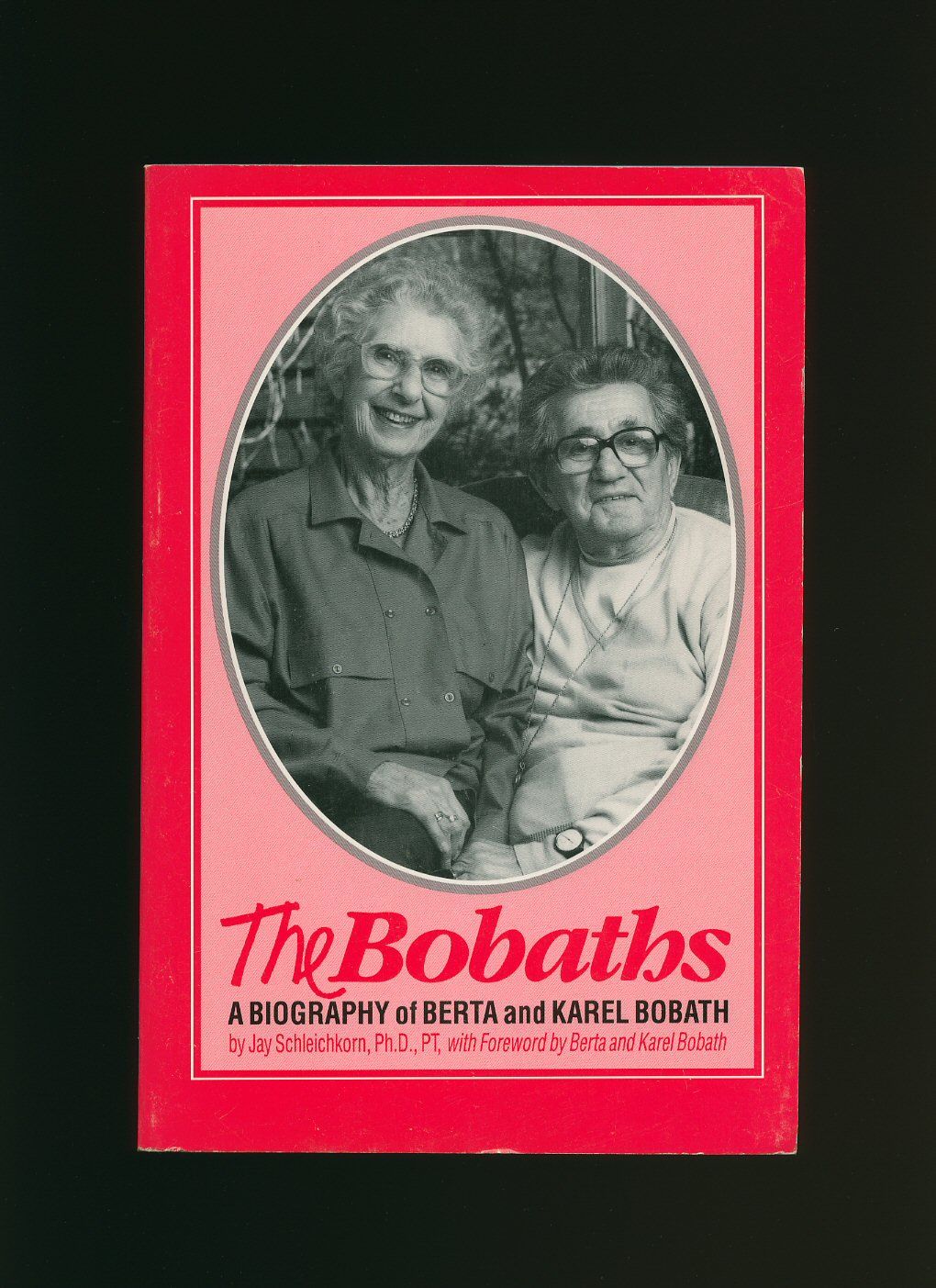
Neuro-Developmental Treatment. That's a lot of syllables. Very scientific sounding. It was developed by Berta Bobath, and for a long time was called The Bobath concept. Let’s just call it NDT/Bobath.

NDT/Bobath has been used on stroke survivors for decades and decades. When I was in school professors talked about it as if it was the most awesomest thing that had ever been awesome. It was the pinnacle. But it was complicated. It was so complicated you couldn't even learn it in school. You have to learn it from NDT/Bobath gurus. You could've gone to the Harvard school of physical therapy (if there was one -- which there isn't) and you still couldn't learn NDT/Bobath. Which is a red flag right there. If it works so well it would be required.

Instead, after graduating you have to go and get "certified" by NDT/Bobath gurus. Those gurus would've learned from other gurus, and up the pyramid it goes. NDT/Bobath training is expensive. We're talking about thousands of dollars and weeks of a therapist's life.

What could they possibly be teaching for that amount of time and money

NDT/Bobath uses "patient handling" where if you touch the patient in a particular way the patient would get better. Which makes no sense. If you could touch somebody and make them better that would be really nice. Touching is great. "Hands-on" is the way many rehab clinicians describe themselves. But does this hands-on treatment work for stroke? Is NDT/Bobath effective?

No and not really.

And how do I know this? Systematic reviews.  Systematic reviews can be used to figure out if anything is effective for anything -- at least in medicine. If you want to be sure that something is effective you turn to systematic reviews. It's basically a study of all the qualified studies of whatever the subject is. This study of studies either says the thing works, the thing doesn't work, or they don't know yet.

NDT/Bobath always does poorly in systematic reviews. And that should be the end of it, right? It doesn't work. Goodbye. But not so fast. I've been doing talks for years to therapists. I've heard every justification for continuing NDT/Bobath.

Here are some arguments made by NDT/Bobath therapists:

1. "There's research that says it works, and research that says it doesn't work. Its 'he said she said.' I choose to believe the research that says it works."

There are individual studies that say that NDT/Bobath works. Individual studies prove little. The real question is, what do all the studies say? Large groups of studies, from researchers around the world, can be looked at and analyzed en masse. These "studies of studies" are called meta- analyses and systematic reviews. For NDT/Bobath there are quite a few; links below. They all come to the same conclusion: NDT is not particularly effective.

2. "NDT incorporates all the latest research into NDT. Therefore NDT is research-based."

I call this the "Horshella." 

Person 1: "I love horseradish."  
Person 2: "Well I love Nutella!" 
Person 1: "Oh, horseradish tastes great with Nutella." 

Maybe. But we should probably test it before we market "Horshella". Smearing NDT/Bobath all over well run clinical trials does not make NDT/Bobath research-based. In fact, it destroys the original research by adding a debilitating confounding variable. Adding NDT/Bobath to a well researched intervention may make that intervention better, worse, or not affect it at all. But the original research was never done with NDT/Bobath, so we'll never know. Stealing other people's research and glomming it does not make your intervention research-based. All you've done is hijacked well run clinical trials, and in the process made everyone look bad.

3. "I don't need research to tell me something works. I've seen it work."

The world is flat. And I can prove it. Look out the window. See? I know global warming is not happening. When I got out of the shower this morning I was freezing! The sun revolves around the earth. Every day the sun comes up over there and goes down over there, so its revolving around us. 

"I've seen it work" speaks to clinical observation, a very important part of being a good clinician. But what if we were talking about cancer? If the oncologist said "I've have this treatment that I've seen work," your question might be, "What does the research say works?" Clinical practice without research is bad for cancer patients and stroke survivors. Clinicians are not blinded, they don't gather and analyze data, they don't have a control group, there is no elimination of confounds and on and on. Simply: Clinical observation won't tell you if A works better than B.


4. "Research doesn't know what works so I can use anything I want."

Here is the American Heart Association Scientific Statement on the Rehabilitation Care of the Stroke Patient. It mentions constraint induced therapy, electrical stimulation, robotics, etc. It not only doesn't recommend NDT, it doesn't mention NDT.

5. "What do I use for very low level survivors? They can't move and/or can't follow directions. So, I move them. At least I'm doing something."

Nothing else stops the plague so we're sticking with leeches. (The difference is that leeches may actually do harm. NDT does not do harm except in the sense that it leeches (!) $$ that could be better spent elsewhere.) 

Remember: There are only two kinds of true paralysis after stroke: Spastic and flaccid. Most survivors can move. Many, however are told not to move on their own because its bad movement, and will cause more bad movement. And who suggested bad movement will cause more bad movement (which is not true)? Bobath! Bobath called the movement after stroke "pathological" and insisted it be suppressed.  To quote Bobath's book, Adult Hemiplegia: The aim of treatment should be to inhibit the patient's abnormal patterns of movement because we cannot superimpose normal on abnormal movements. Let's say that a therapist was able to do this during treatment. Does the survivor not move the rest of the time for fear of abnormal movement?

Later... The movements the patient performs with or without the therapist help should not be done with undue effort. 

Tuesday, January 1, 2013

The problem with Botox

When it comes to spasticity reduction, Botox is the 600 pound gorilla. It is the Oracle. If Oz was the world of spasticity, Botox would be its Wizard. Allergan, the company that makes Botox dictates the conversation. Why? Cold hard cash. Allergan made significantly more than $1 billion in the third quarter of 2012 alone.
 

Keep in mind that Allergan makes other drugs besides Botox. And spasticity isn't the main reason Botox makes 'em money.  The main reason Botox makes money is because of its wrinkle reduction qualities. Bottom line: they have plenty of cash. And they use that cash to influence opinion. This is inevitable, but also unfortunate. The influence that can be bought chips away at a discussion of other possibilities.

What are the other possibilities?

Phenol blocks. In the book "Spasticity: Diagnosis and Management" phenol blocks are called: a "Dying Art" That Merits Revival.
 
Why does it merit revival? Phenol blocks do pretty much the same thing as Botox for spasticity. But it costs less. Much, much less. This is something you should discuss with your doctor. It may be true that Botox is the best option. But it may save you some money to ask about phenol blocks. How much money is saved?

For muscles in the arm/hand, this is one estimate...
Botox: $1014.84
Phenol: $7.85


Another thing about Botox. For a long time the suggestion by Allergan was that Botox should be administered, and that's it. Botox provided a "vacation" from spasticity. They are in the business of selling drugs, not in the business of reduction of spasticity in any sort of permanent way. Remember, Botox does not cure spasticity. Phenol blocks are the same. All Botox and phenol blocks do is provide a window of opportunity to to regain executive (brain) control over spastic muscles. A classic example is of somebody that cannot open their hand. Spasticity in the muscles to close the hand is so strong that they can't open the hand. Botox or a phenol block is used to weaken the muscles that close the hand. This "unmasks" the movement that was always there: Hand opening. Now the hand can open because it's not fighting the spastic muscles that are trying to close the hand. But instead of treating this as a vacation, the person works hard to get the brain re-involved in all the muscles. (Allergan has changed its tune about this with prompting by me and others. They now say: administer Botox and then get therapy.)

During the "vacation" block provide hard work can help permanently reduce spasticity. 

Otherwise, it's just a vacation.

Monday, December 24, 2012

Flexible and measurable DIY plan

Everyone needs a plan. At work we have schedules and care plans and goals. During our education we have schedules and syllabi and tests. Athletes, with the aid of coaches, have a plan for every practice, and benchmarks are built into every practice.

Most stroke survivors don't have a plan. Sure, therapists set a plan with goals during therapy. But once discharged, survivors tend to drift, hoping not to lose what has been recovered.  Instead, the most recovery is achieved when the focus is on further gains.

Upon discharge from traditional therapy, survivors enter a new chapter in recovery. Their recovery plan is essential in optimizing their recovery. This is true for the short-term, and for the rest of their lives. 

There are three aspects to every successful recovery plan.
 
Measurable benchmarks. Gains made during the chronic period after stroke are hard to see because they tend to be modest. Specific goals should be stated and strived for. If the patient says, "I will walk 500 yards by September," then a 500-yard route should be mapped out. The total goal should be chunked in a way that the survivor sees incremental gains toward the entire goal (i.e., 50, then 100, then 200 yards and so on).  

Focus on what YOU can do. For recovery to continue beyond the traditional therapy period, the survivor has to drive his own therapy. This dovetails well with the concept that for the brain to rewire, neuroplastcially, the patient has to drive his own nervous system. The recovery plan should emphasize self-reliance. Not only should survivors be able to do most of the therapy themselves, but they should also understand how to progress their efforts. 

Make the plan flexible. Stroke recovery research is galloping along. What comes of this research? New treatment options. All these new treatments dictates that the survivor be flexible enough to incorporate new ideas into their plan. But there's something else that requires flexibility: the survivor changes. One thing that every researcher agrees about: Intensity rules. So if the survivor chnages and intesity rules, the foucs must change while the level of intesity increases.

Otherwise you're just spinning your wheels.

Blog Archive