Thursday, August 27, 2020

F$#^R& The Plateau!


Three quick suggestions to continue breaking though plateaus: 

Change things up. Do not fall into what athletes call habituation; doing the same thing and expecting better movement. Work (within sane limits of safety) beyond your ability. In other words, the same old will get you more of the same old movement. New, done correctly, will get you new movement.

Let an athletic trainer help you be a better athlete. Explore the option of working with an athletic trainer (AT). (Note: In the USA an AT is a Masters degree. They understand what a stroke is, and safety concerns). The AT may help unleash your inner athlete. Therapists sometimes focus on reducing deficits. They have to: They're trying to get you safe, "functional," and back home. ATs tend to focus on better movement, and will look at survivors the way they look at any athlete. To them, you'll just be another athlete. A "low level athlete playing a higher stakes game."

If you don't work out, plan on weakness. Never underestimate the value of the hard work you are doing in the gym (home gym, place where you exercise/ meditate/ stretch, etc.). Survivors take twice as much energy as aged-matched couch potatoes to do every movement (i.e. dressing, walking bathing). So survivors need “banked” energy to live their life. On top of that, survivors need even more energy to do the hard work of recovery. 

Friday, June 19, 2020

SPACE TO RECOVER—THE HOME GYM

(Note: Having a place to work out at home is essential when COVID-19 makes it hard to attend therapy. Here is a free chapter from my book Stronger After Stroke that offers suggestion for an at-home stroke recovery gym.)

My kids in our home gym

Clearly, it’s easier to study at the library, do paperwork at your desk
, and cook in the kitchen. Every stroke survivor also needs a space within his or her home dedicated to recovery. It should be a space where you can focus on recovering from your stroke. Like a library, it should only have the distractions you want; like a desk, it should be organized; like a kitchen, it should have all the recovery tools you need. Some stroke survivors prefer to pursue at least some of their recovery effort in a community gym. Even if one joins a community gym (see the section Space to Focus—The Community Gym, later in this chapter), there are great reasons for having a home gym as well. 

How Is It Done? 
Your home gym can be a basement, an extra bedroom, or a corner of a room. It does not have to be big and does not have to have any more equipment than you need.

It should have what is necessary to facilitate recovery. This may include exercise equipment, a TV, VCR, DVD player, a stereo, and inspirational art. Build your gym as a place of sanctuary and a place of work. Ideas for equipment include: 
Seven buck at Goodwill!


A treadmill 
A recumbent cycle 
An upper body ergometer (hand cycle) 
An exercise mat 
something used to maintain balance (sturdy chair, etc.) 
Weights 
Resistance bands 
Electrical stimulation devices 
Balls, decks of cards, or other “toys” 
A mirror
This list can be as long or as short as it needs to be. A small amount of simple equipment that is well thought out and well used is better than a lot of expensive equipment left in a corner. Doctors and therapists can help compile a list of needed equipment. 

What Precautions Should Be Taken? 
Be prudent when assembling the gym and think safety first. Any exercise or therapy equipment has inherent dangers. For instance, a treadmill provides a moving surface that may be inappropriate for some stroke survivors. Even something as simple as a ball can facilitate a loss of balance that can cause a fall. Consider installing grab-bars for any balance exercises you do. Make sure the floor is nonslip given the footwear you expect to use. Doctors will tell you if an exercise or therapy is safe, and therapists will explain how to do the exercise or therapy in the most effective way possible.

Saturday, May 9, 2020

Stroke evaluations drop by nearly 40% during COVID-19 pandemic


The New England journal of medicine published an article on May 8th that said the number of people being evaluated in hospitals for stroke has dropped by 40% during the pandemic.

What Covid really looks like
Here is the study's visual description of that drop.
Click to make larger

Not only are they not being tested, stroke survivors don't even come into the hospital, or wait too long to see treatment. And in a situation where time is brain, that is not good.

You can find a layman's perspective of this study here.

Saturday, February 15, 2020

Spasticity: Can ANYTHING be done?

What reduces spasticity?
Does anything eliminate spasticity?  

Below is an outline of various spasticity-reduction treatments.

Treatments that will permanently reduce or eliminate spasticity.

The neuroplastic model of spasticity reduction. I developed this one years ago. You can find an outline of it from my book here. It is the only non-surgical, permanent option on this list. Here is the emerging evidence for the "neuroplastic model of spasticity reduction."
Note: there is a lot of other clinical evidence that this model works, but it is typically wrapped up in research of other therapies that use a lot of repetitions.  Here are some of them:
Dorsal root rhizotomy (or selective dorsal rhizotomy). The one "medical" thing that does reduce spasticity in a long-term way is the one that nobody ever talks about. It's neurosurgery— this is in children, but they do it in adults as well. For the right person, its perfect and permanent.   

Treatments that will temporarily reduce or eliminate spasticity.

Ice. If you ice the spastic muscle for about 20 to 30 minutes you'll get about 20 minutes to a half an hour of a reduction in spasticity. (Technical: It slows the monosynaptic reflex.)

Heat. Don't do it. It exacerbates spasticity (Technical: It speeds up the monosynaptic reflex.)

Weight-bearing. This is one that a lot of therapists love. Whether you're standing on the leg that's spastic, or putting weight through the upper extremity that spastic, there is a reduction in spasticity. That reduction will last until the next big volitional movement and the spasticity comes back. But it is a great short-term strategy that helps set the survivor up for treatments that are more permanent.  

Stretch. Always the first line of defense. There's a lot of good reasons to stretch, but it does absolutely nothing to reduce spasticity in the long-term. This was established by not one but two Cochrane reviews. It didn't even reduce contracture formation. 

Stretch and weight bearing have the same effect, but also give the same head fake; They work immediately, but stop working after the next big (effortful) movement. 

Botox (and other neurolytics). Back in the day there were a couple of formulations of Botox. Eventually you would become immune to one so they'd use the other one. You'd  become immune to the second formulation, and that was the last time it would be effective. Now they have so many formulations that you can be on Botox for the rest of your life. It's a Band-Aid. When it wears off, it's done. It's also an expensive, and often painful Band-Aid. Oh, and it gets in the way of my neuroplastic model.

Electrical stimulation (E-Stim)Typically this involves reciprocal inhibition of the spastic flexors. Put simply: You E-Stim the muscles opposite the powerful flexor muscles that cause the problem. Example: E-Stim the elbow extensors (triceps) to relax the elbow flexors (biceps, etc.). Various doses will provide a temporary reduction is spasticity.

Monday, January 6, 2020

Sorry not Sorry: Stroke Recovery is NOT Proximal to Distal.


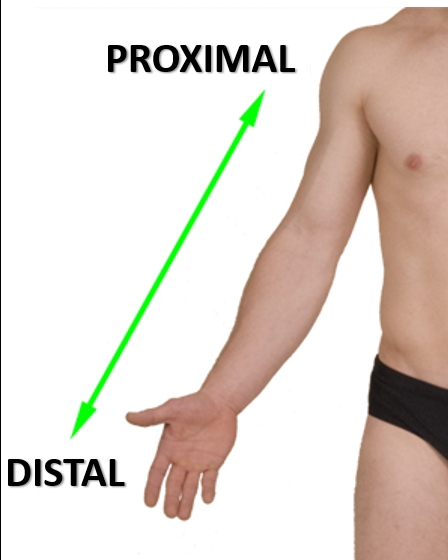
There's an old saying among clinicians: Recovery from stroke is proximal to distal. That is, there is a predictable pattern of recovery: proximal (closer to the body) to distal (further from the body). 

Assuming this may hurt recovery.

The 'proximal to distal' crowd would say recovery in the arm/hand would be in this order:

  • first to come back are the muscles in the shoulder and shoulder blades, 
  • then progress to the elbow, 
  • then to the forearm, 
  • then to the wrist, 
  • then the hand, 
  • then the finger joints close to the hand, 
  • then the finger joints furthest from the hand.…
But proximal to distal is not accurate any more than assuming that the sun circles the earth because it always rises in the east and sets in the west. Both are based on observation, but neither is based on what is actually happens. 

Here's what actually happens:

1.   You have a stroke; one side of your body is affected
2. The proximal muscles (i.e. shoulder) have bilateral innervation; both sides of your brain control the proximal muscles.
3.  Your shoulder comes back first not because of the "proximal to distal rule" but because your brain never ceded control over the shoulder muscles.
4.  The clinician sees the shoulder coming back before everything else and figures, "That's the proximal to distal rule!"

You might argue, "If the shoulder comes back first, then maybe the reason is wrong, but its a distinction without a difference. Survivors will still see proximal to distal return."

But what if the fingers are coming back first? Clinicians may not think to test the hand because the shoulder is not back. Or they may focus on shoulder control even though the hand can drive shoulder control if hand movement is recognized and encouraged.

In the lower extremity, the problem can be even worse. Proximal muscles would move the hip, and those are what are focused on. Meanwhile, an AFO (ankle brace) is routinely put on the survivor even though the ankle (a distal moment) may be coming back on its own.

And AFOs are easy to walk into, but hard to get rid of.

Sunday, November 17, 2019

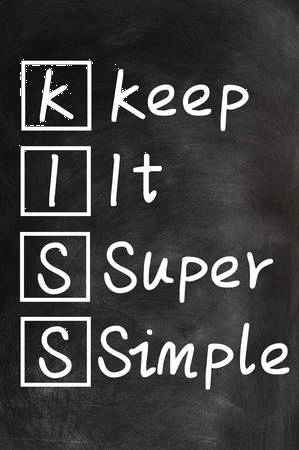
Clinicians: When it comes to stroke recovery: KISS


When it comes to stroke recovery, clinicians would do well to keep it simple.

There's two important reasons...

One. The coolest new stroke recovery stuff comes from neuroscience. And the neuroscience perspective makes things really simple. 

People hear the word neuroscience and they assume everything's going to get really complicated really fast. And while there is nuance in the brain that wins people Nobel Prizes, the global perspective neuroscience provides simplifies recovery. There is good news for people like me who spend a lot of time trying to explain stroke recovery: Some of the greatest neuroscientists in the world are really good at making the brain simple.

In other words, just as you don't need to know where the carburetor is— or even what a carburetor does— you can still drive a car. We don't need to memorize Brodmann areas, or the role of the substantia nigra, or the details of fMRI to understand how the brain works. What's much more pertinent, and much more interesting, are the global perspectives neuroscience provides. That is, if you use neuroscience not to answer "what is a carburetor", but instead to answer "where does the key go?" Where's the knob for the lights? Where's the turn signal? When it comes to the global perspective, neuroscience begins to answer simple but vital questions. Like:  

What does the brain pay attention to? What forces the brain to learn? What kinds of things can fool the brain into learning? What kinds of things—what kinds of simple things—can be used to challenge the brain in a way that's productive for relearning movement after stroke?

Two. The other reason it's simple is purely technical. Only the owner of the brain can drive changes in their brain. Because learning, including what's called motor learning after stroke, requires that the survivor understands the process, on some level at least, it has to be simple. 

Nobody likes complexity. But complexity can be even more vexing to somebody who has suffered a brain injury. Don't get me wrong, I've met plenty of survivors that are smarter than I am after their stroke. But most people have had a stroke are focused on recovery and keeping their life somewhat on track than complicated recovery options.

To review... 
It has to be simple because it is simple, and because stroke survivors generally don't do complicated.

Here's the good news: the stuff that works the best is really simple. It relies on core concepts like bilateral training, introducing rhythmicity, forcing use, repetitive practice, etc

I do a lot of talks to clinicians. And it's amazing how many people will trust a complex treatment that they really don't understand over a simple treatment that they would have understood the moment they learned how to walk. What I would counsel therapists is this: If it's too complicated for you to get it from a simple explanation, you should probably save your money and save your patient's time, because that complicated stuff usually doesn't work.

Saturday, October 5, 2019

What is stroke recovery?

What are stroke survivors trying to do? They're trying to move better. 

Where does better movement come from? The brain!

Is the brain learning (new brain connections) or relearning (using existing connections)?

This debate has been around for a long time. Here's the question restated: If you've had a stroke and you're learning how to move better everyday. Is that movement learning or movement relearning? Is it new stuff (new neuroplastic change) or are you reactivating a part of the brain that used to do that movement?

I've been pretty successful selling to the world that it is all about neuroplasticity-- that it's all new learning. But that's only once the plateau has been reached. You know the plateau, that first big reduction in recovery? Prior to that most recovery comes from the brain "healing" (although "coming back on line" is a better description).


Click image to make bigger


So, lets review:

Before the plateau: Using brain that already knows the movement.

After the plateau: Using new brain to do the old movement.

Thursday, September 19, 2019

Mental Practice Recordings now available!

Bottom line: We studied the effects of mental practice (MP) on stroke recovery. We used recordings so that participants would have a guided imagery experience. These recording were never made available to the general public. Now, an analog is available.  

To find the recordings, do this: At the top right-hand side of this web page is a button that says Mental Practice Recordings for Stroke Recovery. You'll find the recordings there.

My first job in clinical research was at the Kessler Institute in New Jersey. I was teamed with a scientist, Stephen Page. Steve had been a D1 swimmer at University of Tennessee. Prior to getting into rehabilitation I was a musician. So we had an athlete in the musician.  And we had support from Kessler's very large research department.

Early in our relationship Steve told me he wanted to do a study on mental practice (MP). MP is what athletes and musicians do to practice. But they don't actually physically practice, they only imagine the movement. When Steve told me he wanted to MP with stroke survivors I advised him against it. I didn't think the very soft "imagining" would get its butt kicked by the realities of hemiparesis and everything else that comes with stroke. A few weeks later he came to me and said, "I want to do mental practice for imagery with people with stroke". And again I advised him don't do it. And he countered with, "Well we got funding." So I said, let's do it!

There are a few things that our lab was known for. We were known for dosing studies with electrical stimulation. We were known for being the first to modify constraint induced therapy. Sometimes we combined MP with modified constraint

And we were known for early mental practice. Here's an early one, here's a later one. The MP stuff may have had the biggest impact. Therapists like it because they don't have have to burn through a lot of clinical time because the survivor did it themselves. And it didn't stress the survivor for two reasons:

1. There was a deep breathing part to begin and end the MP session, so it may actually reduce stress.

2. There was no actual movement, only imagining the movement, so there was no muscular stress.

And survivors liked it because they could do it on their own. they could do it after they had been discharged from therapy. And its didn't cost them anything.

Tuesday, August 27, 2019

The bad news is, you may be flaccid. The good news: You may not be.

Flaccid. The word is used to describe a lot of stuff from music to political rhetoric. And it's never good. "Dude your band is totally flaccid!" said no one ever. And when it comes to body parts, its a bad thing. It can be used to describe many body parts that are not doing their job, from ear drums to muscles. 


If, after stroke, a muscle is described as flaccid, it has no movement, and no "tone." Tone means that on some--even nominal--level the muscle is working. 

If a survivor is flaccid on the "bad" side, there is no movement, no tone, no reflexes, no nothing. And if someone moves the survivor's limb it feels like moving an unattached door hinge: There's no resistance. But having a floppy arm is not the only problem. 


Subluxed right shoulder

Because muscles do more than just move things, there can be orthopedic problems. One of them is shoulder subluxation (dislocation). The muscles that hold the shoulder in its shallow joint are called the SITS muscles. When these muscles are flaccid the arm literally falls away from the joint. There are also pain syndromes associated with limb flaccidity. An example is called shoulder-hand syndrome.

Stroke survivors are often flaccid on the "bad" side immediately after their stroke. The good news is that, as the brain comes back online, flaccidity usually goes away. Usually.

But let's step back for a second. Clinicians often misdiagnose someone as flaccid. They might move the limb around a little bit and think, yeah, its flaccid. How might they prove its flaccid? They'd have to "add velocity." That is, they'd have to move the limb rapidly. But how much velocity? How rapidly? Well, to quote myself, Because spasticity is “velocity dependent” (the faster the limb is moved, the more spasticity is encountered), the test is done moving the limb at the “speed of gravity.” This is defined as the same speed a non-spastic limb would naturally drop. In other words, fast. This test is called the modified Ashworth. And its almost never done in someone who is "low tone" after their stroke.

So before the clinician claims you're flaccid, with the concomitant bad prognosis, make sure they do the Ashworth in any muscle they're claiming is flaccid.

If it remains flaccid the first week after stroke, the final outcome is usually poor.

Monday, June 10, 2019

Poor Sleep? Poor Recovery.


Getting decent sleep is essential to stroke recovery. This is not some loosey-goosey pseudo-scientific "pathway to happiness" that then somehow reflects back on your recovery. This has to do with the hardware of the brain.

Think of the brain is a big bucket of one thing:  neurons. You have about 86 billion of them. Or at least you did prior to your stroke.

Neurons are very much like muscle fibers. If you want to build a muscle stronger, you stress it, usually with resistance training, until it micro tears. That micro tearing causes a form of pain called delayed onset muscle soreness (or DOMS). Once the muscle is micro torn, it triggers new and/ or bigger muscle fibers. That's how muscles grow.

Neurons Grow Like Muscles

Muscles grow when they're stressed with exercise, and neurons grow when they're stressed. How do you stress a neuron? Learning. And after stroke, you are learning. Its called motor (movement) learning. When you motor learn, you stress neurons. Neurons respond to the learning/ stress by triggering protein synthesis, which form new connections and voilà! You've learned that movement.


Neurons use the synthesized protein to build new dendrites. Those dendrites then build new connections to other neurons. But the actual connectivity part is done while you're sleeping.  

So literally, if you don't sleep you don't recover.

And we're not talking about drugged sleep. That's called sedation, and the brain does not learn new movement (or anything else) when you're sedated. But its tough for stroke survivors to not take meds that sedate them. Consider spasticity meds. They're downers (CNS depressants), and will interfere with the deep sleep that the brain needs motor learn. The problem with sleeping pills—and depressants generally—is that the brain is not able to do the hard work it needs to do to consolidate what you learned while you're recovering.

So let's say you're in therapy. And every day your therapist is trying to help you relearn how to walk. In order for new neurons to take over for the ones that were killed by the stroke, you have to learn. Learning requires sleep. So you can work your butt off in rehab, and not have much to show for it, because you're not sleeping well.

Again the consolidation of what you learn during the day happens while you're sleeping at night.

Here are some suggestions to get to sleep...

Daytime Suggestions
·   Set an alarm to try to wake up at the same time every day.
·   Include meaningful activities in your daily schedule.
·   Get off the couch and limit TV watching.
·   Exercise every day. People with TBI who exercise regularly report fewer sleep problems.
·   Try to get outdoors for some sunlight during the daytime. If you live in an area with less sun in the wintertime, consider trying light box therapy.
·   Don't nap more than 20 minutes during the day.

Nighttime Suggestions
·   Try to go to bed at the same time every night and set your alarm for the next day.
·   Follow a bedtime routine. For example, put out your clothes for morning, brush your teeth and then read or listen to relaxing music for 10 minutes before turning out the light.
·   Avoid caffeine, nicotine, alcohol and sugar for five hours before bedtime.
·   Avoid eating prior to sleep to allow time to digest, but also do not go to bed hungry, as this can also wake you from sleep.
·   Do not exercise within two hours of bedtime but stretching or meditation may help with sleep.
·   Do not eat, read or watch TV while in bed.
·   Keep stress out of the bedroom. For example, do not work or pay bills there.
·   Create a restful atmosphere in the bedroom, protected from distractions, noise, extreme temperatures and light.
·   If you don't fall asleep in 30 minutes, get OOB and do something relaxing or boring until you feel sleepy.
·   Going to bed and getting up at the same time every day.
·   Removing electronic devices, such as televisions, computers or cellphones, from the bedroom.
·   Avoiding large meals, caffeine and alcohol before bedtime.
·   Making sure the sleep environment is quiet, dark and not too hot or too cold.

Steps to Better Sleep Hygiene:  Behavioral Changes
·   Regular risetime and bedtime—by doing this every day,you can help your internal clock by providing regular cues, thereby improving your sleep-wake cycle.  This should help in getting to sleep faster and reduce the number of nighttime awakenings.
·   Get plenty of bright natural light exposure, preferably in the morning along with exercise. This will give your internal clock a strong cue to run on time.
·   Avoid stimulants, such as caffeine and nicotine.  Avoid caffeine-containing drugs, drinks, and foods for eight hours before bedtime.  Avoid tobacco in the evening.
·   Avoid thoughts or discussions about topics that cause anxiety, anger, and frustration before bedtime. 
·   Institute and maintain a definite bedtime routine that is relaxing to help signal the body that sleep is to occur soon.  Examples might include: a bath, brushing teeth, a small glass of warm milk (4-6 oz.), or a light snack. This will help with getting to sleep and will reduce the need to awaken due to hunger.
·   Reserve the bedroom and especially the bed for sleeping. Avoid activities like reading and watching television in bed. Your body needs cues to associate the bed with sleeping and not other activities.
·   If you nap, try to do so at the same time every day and for no more than 1 hour, and ending by 3pm.
·   Don't spend more than 15 minutes trying to sleep—if you cannot sleep after 15 minutes get out of bed and engage in a quiet activity.  Ideally, the activity should be in low light and sedentary, for example, listening to soft relaxing music or meditating, not reading with a bright light or watching television.  Return to bed only when you are sleepy.

Staying asleep
·     Minimize light and noise at bedtime and throughout the night. This will reduce stimulation and promote normal function of the body’s melatonin rhythm that helps to promote and maintain sleep. Ear plugs may be helpful if the environment is noisy. Avoid alcohol within 4-6 hours of bedtime.  When taken at bedtime, alcohol may help induce sleep but disrupts sleep later in the night. 
·     Avoid heavy exercise within 6 hours of bedtime.  Exercise increases the body temperature. Sleep onset normally occurs as the core body temperature is decreasing. Artificially increasing body temperature can therefore give the wrong cue to the brain and contribute to sleep disruption. 
·     Avoid heavy late night meals. They can interfere with the ability to fall and stay asleep. A light snack at bedtime, however, may promote sleep.  Good bedtime snacks include dairy products and carbohydrates. 
·     Assure the bedroom environment is right for sleep: comfortable bed, dark, quiet, and a cool temperature for sleeping. 
·     Avoid looking at the bedroom clock if you awaken. If necessary, face the clock to the wall. 
Moving in bed
·     Use satin sheets on the bed or pajamas to help with moving in bed can minimize the effects of stiffness/pain.
Waking to go to the bathroom
·     Decrease evening fluids (3-4 hours before bedtime) to lessen the chance of waking up to go to the bathroom.  Make sure that you drink plenty of fluids in the morning hours.  If you often get dizzy when you stand, sit on the side of the bed for a moment or two while flexing your leg muscles before you stand up.
·     Go to the bathroom immediately before retiring.
·     Add some stress-relieving exercise to each day. Walking counts!
·     Helpful Hints: 
·     Stress can keep you from getting enough sleep
·     Exercise can relieve stress and help you sleep well at night
·     So can mindfulness, meditation and deep, diaphragmatic breathing
·     7-9 hours is considered “enough” sleep for most adults
·     Plug your phone and other electronic devices in away from your bed. Helpful Hints:Scrolling and staying connected late at night could be sabotaging your sleep cycle
·     Choosing to get enough sleep at night over getting more work done could help you be more productive
·     Bright, blue screens may inhibit melatonin production – keeping you awake longer
·     Set a “bedtime” alarm for each person in the family.
·     Helpful Hints:
·     Going to bed and waking up at a consistent time can help you sleep better
·     To set your bed time, figure out your ideal wake time and count backwards from there
·     A nightly routine with time to wind down could help you stick to your bedtime
·     If you’ve tried everything and still can’t sleep well, you may have a sleep disorder – talk to your doctor to find out what to do
·     Start your morning with a healthy habit, like a walk around the block or a moment of gratitude.
   
Helpful Hints
·     Adding a positive activity to your morning routine could make it easier to get up if you’re a late snoozer
·     Sleeping past your alarm can make you groggier in the morning
·     Habit chaining may help establish new habits, like doing a few push-ups right after you brush your teeth
·     Add a 20-minute power nap to your afternoon.
·     Helpful Hints:
·     An afternoon nap can help you re-energize and power through the rest of the day
·     “Catching up on sleep” is a myth – sleeping in on the weekend may be sabotaging your weekday sleep cycle
·     It may take a few weeks to get used to your new sleep cycle, so stick with a consistent bedtime and take naps when you need to

Blog Archive